The Rilindja Archive, a virtual archival-museum initiative that has aimed to map the journey of the Rilindja enterprise over the years, was launched in 2019. This long-standing initiative has, for many years, collected necessary materials, interviews, and other textual and visual documents, with the goal of raising awareness among institutions responsible for culture, science, and heritage about the need to protect this national treasure.
Until 2019, the Rilindja enterprise—which should have been a priority under state support—had its machinery sold at scrap value (machines that the state should have purchased and preserved as museum assets), its space was taken and alienated, its materials were appropriated by private individuals, and its newspapers and books were mistreated.
I, as an activist collecting these materials (which I still preserve under home conditions, entirely on a voluntary basis), as a persistent advocate for reviving the debate about Rilindja, and as a passionate researcher of its history, have been convinced that after all these efforts, joined by many researchers and activists, Rilindja would have a deserved space for documenting its intellectual journey.
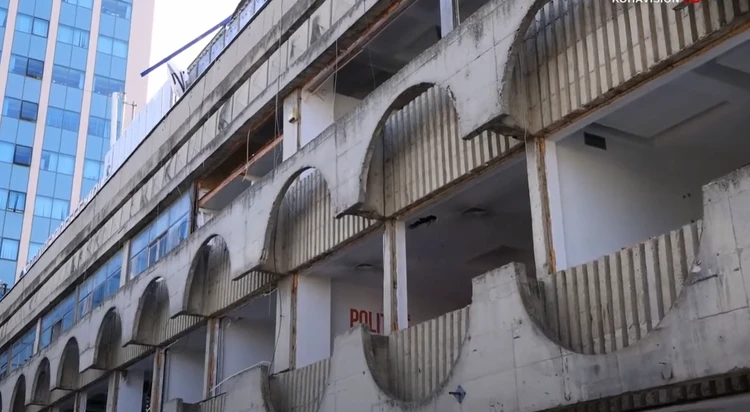
I have painfully experienced the fact that Rilindja’s 18-story building has been stripped of its identity, with its rich library on one of the floors destroyed and every office renovated to be repurposed for something completely different. Yet, somehow, I rationalized this repurposing with the poverty we have for functional spaces.
But I cannot rationalize, nor digest, the fact that the Rilindja printing press space—which until 2019 was still filled with the machines that smelled of motor oil, with the former employees’ metal cabinets full of items and posters, and with worktables still bearing Rilindja’s seal—has suddenly disappeared, while the space has been remodeled, with the machines removed one by one. These machines, once attractive accessories for partygoers who paid high ticket prices to show loyalty to internationally renowned DJs, were jumped on by drunken and drugged revelers spilling cheap alcohol and vomit over them.
I was glad that a very small part of this space, compared to the “usurped” portion, was temporarily preserved thanks to our voice and the support of Manifesta in Prishtina. I sent several proposals for how that space, however small, could be used to document Kosovo’s press from 1945 onwards, which would automatically reflect every intellectual movement, every effort, and even the absence of political efforts by the people of Kosovo.
Early on, different interest groups were formed around that piece of space. All claimed to act in the name of saving it, yet each group, in its own way, sought to use the name of Rilindja to justify their request for the space. The struggle over that space, by certain interest groups—including artists and intellectuals—was just as undignified as the silent decline of Rilindja itself after the war.
My perspective—that the space should be dedicated to a comprehensive documentation of Rilindja, transformed into a documentation center as a basic ethical minimum for preserving this heritage—was often labeled as conservative and outdated. In numerous discussions, in which I often participated with a sense of anxiety, attempts were made to repurpose the space, to use Rilindja’s name regardless, but as a multifunctional umbrella, perhaps only allowing a small corner to preserve some materials that would briefly acknowledge that the space had once been a printing house, as if it were just a neighborhood print shop.
With this “conservative” perspective that I held—because someone devoted to the preservation of heritage perhaps should hold such a view—I felt deeply that we were exploiting misguided and highly dangerous policies, which in the long term would cost us profoundly in terms of our collective identity. Unfortunately, perhaps unintentionally, we are imposing an overlay on memory, a superimposition of narratives, and this phenomenon is scientifically recognized in practices of policy-making that, very diplomatically, construct a new narrative that is more attractive for the present, “community-based,” so as to overshadow a heritage without entirely erasing it, instead exploiting the reputation and prestige it carries in current collective memory. We can recall Paul Connerton (How Societies Remember, 1989), who argued that societies do not forget randomly; they structure forgetting to create a new symbolic order. Thus, building a new institution on a symbolic old space is an act of organized forgetting: forgetting becomes a mechanism of power.
Has this exactly happened when it was decided that the Museum of Contemporary Art should be located in the Rilindja space? In the multi-page draft of the project for establishing this museum, Rilindja is mentioned only in a short paragraph, just for show. What I still do not understand is whether these policies have been driven by arrogance, ignorance, or are intentional? – Do we even have a strategy for how we want to imagine ourselves as Kosovo through cultural memory in a broader and long-term plan for the generations to come? – Because, among other things, this is the core of cultural policy. As for my “conservative” opinion on this museum, honestly, I find it hard to comprehend within the context of a country like Kosovo, which has not yet managed to establish even the basic foundations for the conservation and design of art heritage, and which does not have a clear narrative for designing collective memory. We do not even have a single art museum in Kosovo—neither from the post-World War II period, the Socialist Realist era (1940–1950), nor from the modernist period initially recognized here as Yugoslav modernism (1960–1970), nor from the Neo-Avant-garde of the 1980s, nor from the 1990s, which is a very atypical year for the continuation of art currents in Kosovo. By creating a Museum of Contemporary Art as a central umbrella, a central institution that would encompass without focus or continuous narrative also several other currents and periods, including Rilindja (which belongs to a completely different heritage domain), we are implementing an extremely flawed policy of cultural improvisation, even bordering on charlatanism. In the context of Kosovo, where institutional culture is still being rebuilt after the trauma of war and the disintegration of Yugoslavia, the establishment of a Museum of Contemporary Art without a national art museum implies an attempt to assert state identity through the new, leaving the past in the shadows, only in the memory of names and symbolic remembrance. Symbolic memory is not spiritual memory; it does not transmit the sense of belonging to future generations, it does not ensure continuity. The generations to come will face a profound identity crisis, unable to understand their social and cultural continuity. In this sense, the Museum of Contemporary Art is not merely an institution, but a mechanism for producing a new cultural identity, detached from the continuities that do not serve the current political discourse. It is a highly mistaken step in cultural policy, which should be very transparent to avoid favoring any particular interests without prioritizing national memory through culture—a crucial element not only of social heritage but also of psychological heritage. Here, I see very poor institutional awareness regarding heritage and an extreme euphoria among individuals and organizations benefiting from funds and subsidies, who lack awareness of continuity and do not understand how important it is to keep even the new alive. The new should be built only after we have properly strengthened the memory of the old. Kosovo is thus presented as new, dynamic, creative, European, while the histories of complexity and intertwinings that shaped it remain silent. This is a selective act of memory, which can be seen as a politics of forgetting through modernity and temporary interests.

Ervina Halili
Author, researcher, and scholar of literature

The blog was published with the financial support of the European Union as part of the project “The development of art criticism”. Its contents are the sole responsibility of Hani i 2 Robertëve and do not necessarily reflect the views of the European Union.