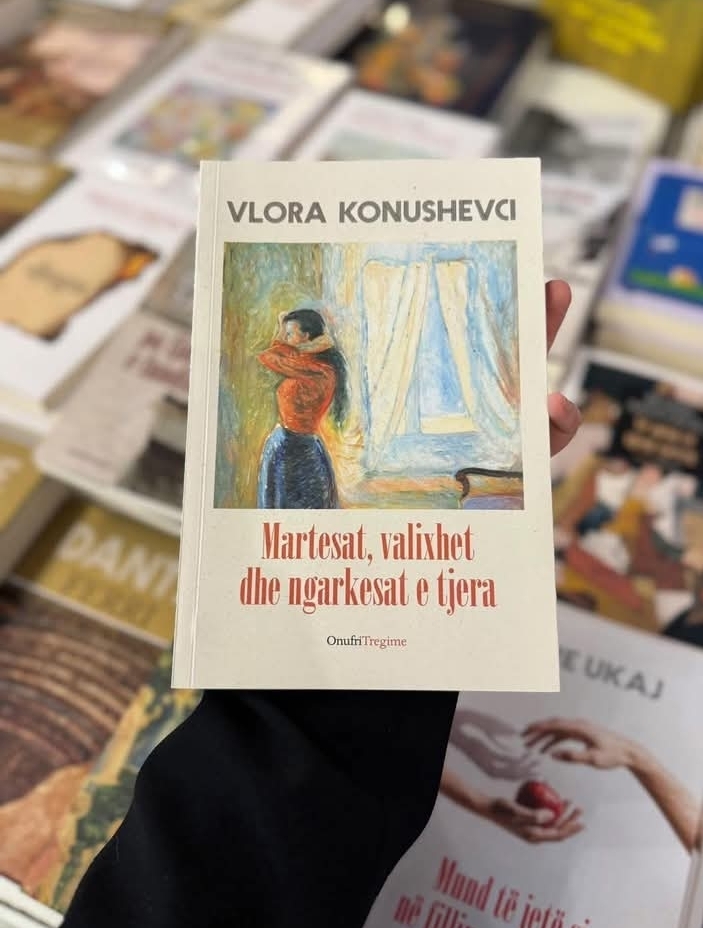
“Marriage, Suitcases, and Other Burdens,” by Vlora Konushevci
The title “Marriage, Suitcases, and Other Burdens” juxtaposes the word marriage, a term layered with social, legal, institutional, cultural, normative, emotional, and symbolic meanings (indeed, a word that marks a theme without which much literature would not exist, at least not as we know it), with the word suitcases, a notion rooted in tangible, concrete, and practical meaning. To these two words are added “other burdens,” a generalization that introduces a particular kind of humor, constructing an image in which all of life’s burdens can be packed together and closed in a square box, and in which the weight of our experiences can be carried, moved, placed, shifted, and even laughed at.
The title is the first point of contact with a book it either grabs your attention or it doesn’t. From the very title of Vlora Konushevci’s collection of short stories, one notices a sharp style, with humor that lingers in the mind, coming from a fresh voice in Albanian literature that offers a compilation of short stories marked by sensitivity, wit, and a distinctive style.
In these stories, the author employs a first-person narrator, giving the narrative a personal and intimate tone, reminiscent of oral storytelling, memoirs, or diaries. This approach also creates the effect of directly conveying events and emotions. The technique encourages the reader’s active engagement in interpretation, since not everything told in the first person is necessarily reliable, thereby challenging the reader’s understanding and fostering active participation throughout the reading experience.
A similar effect of direct communication with the reader is achieved through the use of dialect in the narrative. While in our context dialects are often employed in public discourse to express specific identities or even ideological positions, in these stories the dialect appears naturally and fluidly, without ideological burden. It functions as a stylistic marker of the narrator’s voice, enhancing the authenticity of the literary narrative.
The choice of such a narrator, first-person and in dialect, which reinforces the sense of immediacy, also avoids the privilege of omniscience that a distanced third-person narrator might have, thereby making the reader more sensitive to evaluative, judgmental, or moralizing nuances. Vlora sidesteps these negative connotations of narrative intrusion through a conversational and humorous tone, occasionally ironic, as well as through dialogue. I will illustrate this with a fragment from the story "The Iron": After all, what normal person enjoys talking about old nonsense before even having their morning coffee? I thought to myself: “In life, there’s always some Tina who reminds you of what you’d rather forget.” From the story, here is a short fragment: I walked past him, but I didn’t need to touch him to push him aside. He moved on his own, without turning toward me, as if he were used to making space for something that neither touched nor concerned him.The sense of coldness and emotional distance emerges without intrusive commentary, and the atmosphere of sadness is conveyed through what is left unsaid, giving the narration a quietly painful tension.
The stories in this collection encompass various thematic layers, ranging from intimate relationships and personal emotions to social realities and historical reflections. In the story "Glory", the war is not narrated through grand gestures or heroic rhetoric, but through unsettling details that reveal the absurdity of the bleak lives of characters who are not symbols but ordinary people, worn out and emotionally exhausted: I called his name, but my voice came out faint, as if I had become someone else myself. He turned his head slowly. His eyes, which once betrayed every thought he had, now told me nothing. It was as if everything inside him had died. He barely whispered my name - his voice, that weapon I had hoped would serve others, was drained. It was gone. And with it, every thread of hope that had brought me there… And so, the state takes care of us, the wives of martyrs, the witnesses of this farce. With every pension, it is as if they tell us: “Here, you’ve earned the right to stay silent for one more month!”
The story “Three Rooms” approaches the theme of drug addiction through the eyes of a mother, without dramatizing or moralizing, focusing instead on subtle details, such as: The fluorescent light flickered on and off slowly, as if wanting to confess that hope is never whole, only pieces. The narration avoids stereotyping and conveys a restrained yet persistent pain, the pain of a daily, ongoing destruction.
One of the features of modern prose is metanarration, or the narrator’s commentary on the act of telling the story itself, sometimes even on the function of storytelling. I illustrate this with excerpts from the stories “The Traveler” and “The Suitcase”: When I walked away, I felt the weight of my suitcases. Not the ones at the counter. Mine, the ones I always carry. In my chest. My own personal weight, accumulated over the years, like clothes I can’t throw away because maybe “the day will come when they’ll fit me just right.” How much I had run away from my own life, inventing stories for someone who doesn’t even know who I am… For a moment, my gaze stopped at a stain on the carpet. It was small, almost invisible, but it called me to wipe it. My fingers moved across the carpet, drifting unconsciously over the tiny stain. Every word I wanted to tell him felt like that stain—stubborn, unspoken, impossible to erase. A sudden urge overtook me. The urge to confess. Everything. But I just smiled and said:
Yes, darling, we’ll have a look.
Today, storytelling and narrativity are seen as phenomena through which we understand the world, cognitive activities rather than merely qualities of literary or linguistic texts, allowing scholars to identify narrative traits regardless of the medium. The narrativization of almost everything, now omnipresent, emerges in the narrator’s references to the act of narration itself in these fragments, where the story of the self departs from the story of others, and where the uncertainty of words and their inability to be fully spoken invite the reader to participate in the narrative.
This feature of storytelling is connected to the way identity is perceived today - as an unstable, fragmented, and constantly shifting construct. This type of text draws attention to a concept that lies at the core of contemporary ideological and cultural discourse, intertwining with the literary narrative, and is especially evident in the story “The Market”: “Yes, that app! Yes! The one where we create communities, inspire people, and have influence. For example, my latest collection of bags sold out within a week. Haven’t you heard about it? – No, I haven’t. But I find it interesting that your influence seems to have to do with bags… – The bags I promote aren’t just products, they’re manifestations of our collective identity!” the other replied. Zana burst into laughter. I could barely hold mine in. But a kind of weariness washed over me, one that wasn’t tied only to the conversation. It was that feeling you get when you watch the world slipping into nonsense and you’re standing there among it, just to prove to yourself that you don’t need to become part of it.
This book, with the humor hinted at in its very title and its conversational tone, perhaps suggests that the weight of life becomes easier to carry when shared in stories with others. I hope readers experience this sense of lightness. In the background of this book, from time to time I felt, like a quiet presence, the poetic sensitivity and the calm strength of the voice of the author’s late father, the poet Abdullah Konushevci.
Lindita Aliu Tahiri, Associate Professor, PhD
Lindita Aliu Tahiri is a linguist, literary critic, media and mass communication researcher, poet, literary translator, and lecturer at the University of Prishtina since 1984. She has published books and studies in the fields of critical linguistics, literary criticism, stylistics, and discourse analysis.

The blog was published with the financial support of the European Union as part of the project “The development of art criticism”. Its contents are the sole responsibility of Hani i 2 Robertëve and do not necessarily reflect the views of the European Union.