Photo: Kushtrim Haxha
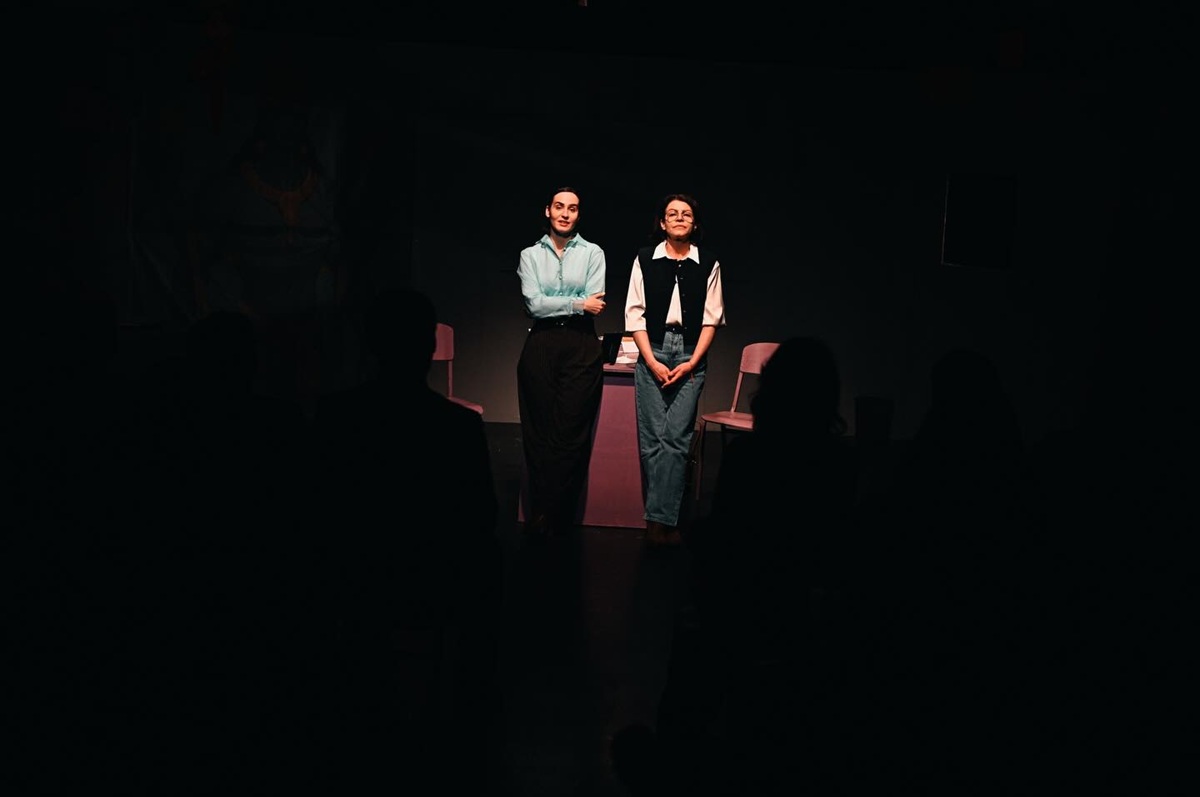
On February 20 at 8:00 PM, the play Gidion’s Knot, written by Johnna Adams and directed by Hana Qena, premiered at the Amphitheatre of the National Theatre of Kosovo.
The play Gidion’s Knot is set inside a classroom, but that classroom is more than just a physical space, it transforms into a territory of moral tension, an arena where not only two women confront each other, but two ways of understanding the world. The encounter between the mother and the teacher goes beyond mere dialogue; it is an emotionally charged duel that addresses parental responsibility, violence, school bullying, and, above all, the fragile boundary between guilt and innocence. In this space, in real time, two worldviews collide along with two different concepts of responsibility, education, and that unsolvable knot that arises when morality no longer has a clear center.
Inside the Classroom of Society
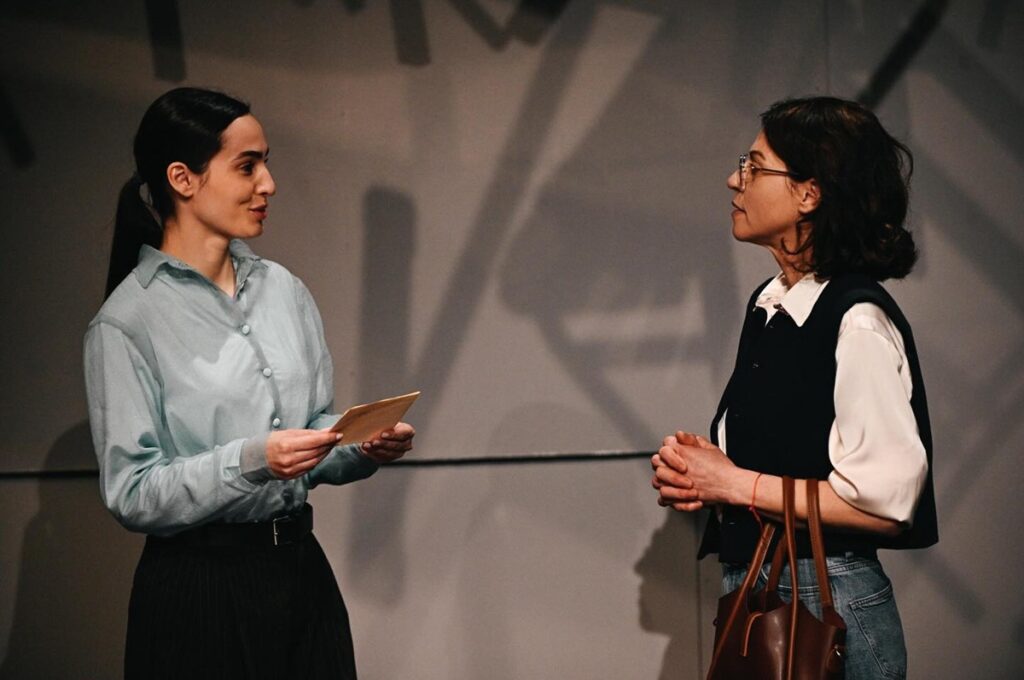
With two actresses and a story that gradually unfolds in different layers until the very end, the play Gidion’s Knot takes us on a marathon of events that touch what cannot be seen with the naked eye in the society we live in every day, the silent mechanisms of guilt, judgment, and fear. A classroom teacher and a mother (whose son committed suicide just days earlier) confront their thoughts and worldviews down to the finest knot of truth.
While Gidion’s teacher’s innocence cleverly anchors the audience’s perception to see the mother as shaken by the unreasonable, the flow of the text and other details in this exchange confront us with a truth that is not linear, it contains multiple truths within itself, like layers that do not immediately reveal the core.
Heather (the teacher), in this encounter, carries on her shoulders the weight of the institution, justice, the law, the school, and, ultimately, her own conscience, a burden that renders her figure tragically compelling. Corryn (the mother) is not lacking in rationality; she is lacking in time. She has missed parent-teacher meetings because she herself teaches poetry at one of the country’s universities. But in this meeting, she does not come merely as a mother; she comes as a moral and legal agent, seeking the true reason behind her 11-year-old son’s suicide.
The discussions, emotions, tension, and demand for answers reveal something that we as a society do not know how to clearly categorize as right or wrong. And this is precisely the core of the play: there is no universal formula for being a good teacher, just as there is no exact manual for being a good parent. Morality is not an equation with a single solution.
The teacher, the mother, or both
In a review years earlier in Chicago Critic, the play’s concept focused on the realms of education, bullying, misunderstanding, and the rigid educational system, not just in a specific country, but in modern societies more broadly. The same impression was felt on the night of the premiere.
Before taking his own life, Gidion had been suspended from school. The reason for his suspension was a story he had written, which had circulated among his classmates, some of whom were involved in it. The story contained violence, resentment toward teachers, assaults, and dark forms of wrongdoing. But Gidion was the son of a poetry professor, who from an early age had nurtured him with tales from Greek mythology and other classical stories. Mythical narratives carry violence, power, tragedy, but also heroism. They are a reflection of human nature.
Apparently, Gidion (as portrayed by the teacher) had a crush on one of his classmates. And here begins another layer of conflict: identity, rejection, and fear.
The questions the play raises and leaves unresolved are deeply philosophical:
Is the way Heather is teaching truly the right way to be a teacher?
Does imagination of any kind matter for an 11-year-old child?
What is the right way to be a parent?
Should a parent be constantly present, or only in specific situations?
If culture is what a parent wants for their child, is exposure to myths and stories containing violence harmful?
These are not just questions for the characters. They are questions for us.
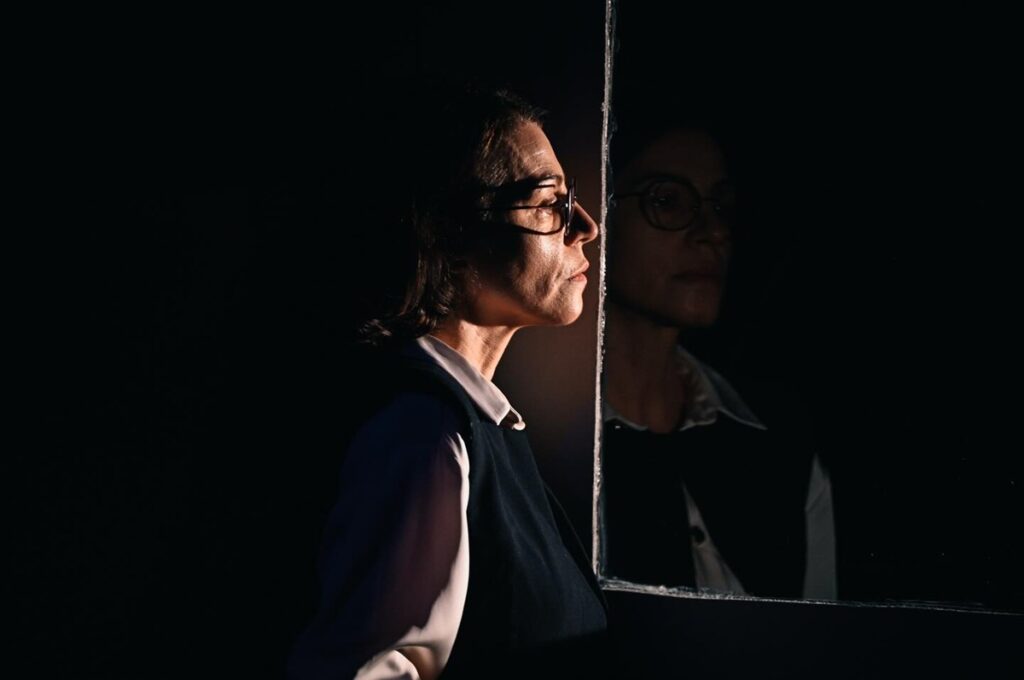
Photo: Kushtrim Haxha
Before we watch the scene
Gidion’s story is among the most beautifully written tales ever read. Even though it contains violence, in literature such a narrative is an artistic achievement. But what remains unresolved is this: should it have been written by an 11-year-old child? And should other children have read it? Because at the end of the day, we are not all the same, and not everyone is like us.
Bravery, strength, and other forms carried in stories by various authors, including mythological tales, can indirectly become punitive for those exposed to them, especially in the absence of emotional maturity.
The teacher, who no longer knows the beginning of right and wrong, has become deeply immersed in a system that teaches her that school is a place where unconventional imaginations must be controlled and that the institution stands above the individual.
The metaphor of her cat, suffering from diabetes and soon to die, is a powerful symbol of guilt and excess. When Corryn tells her, “You are guilty” (because she had overfed the cat), she could, in fact, also be addressing herself. For according to a fundamental life principle, anything in excess is harmful: too much food leads to illness, and uncontrolled exposure to violence can result in emotional insecurity.
And at the end of this metaphor, what stands out is the quiet tragedy: the teacher does not break down in tears over her student who took his own life, but over the cat. Here, the play gives us a cold reflection of the modern individual, one who grieves for what belongs to them personally.
On the actors and the set design
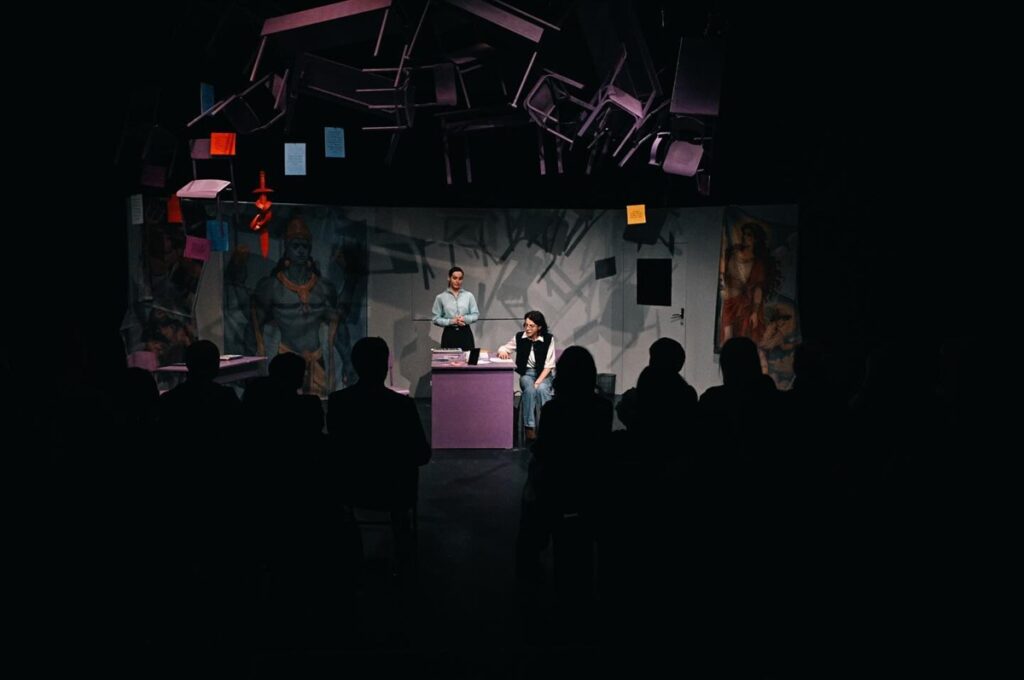
The improvisation with chairs for the audience, intended to make them feel like they were in a classroom, was weak. Those who did not sit in the first two rows found it difficult to see the movements on stage.
But the construction of the classroom and its arrangement on stage were fantastic, especially the suspension of desks and chairs above the actors’ heads, a visual symbolism of the pressure weighing down on them.
Irena Aliu and Maylinda Kasumoviq embraced each other’s performance and made their work easier. The confidence in their actions and the emotional outbursts between scenes were a necessary driving force for a drama that thrives on tension.
…
Gidion’s Knot is a play that cannot feel distant to our audience. Although it arrived later, it is a production that benefits society just like any form of art that awakens and provokes.
This play does not belong to those where tragedies remain silent beneath the protagonists’ agony; on the contrary, it balances reason and emotion and calls for reflection on the unsolvable knot of the most difficult human roles: teaching and motherhood.
Author: Johnna Adams Director: Hana Qena Actresses: Irena Aliu, Maylinda Kasumoviq Playwrite: Zoga Çeta Çitaku Costume Designer: Hana Zeqa Set Designer: Burim Arifi Composer: Ger Kacerja Assistant Director: Fluturë Nishori Animation: Flaka Kokolli, Elsa Talla, Leonita Thaqi, Diellza Franca Stage Manager: Nazmije Krasniqi Designers: Nita Qahili Photographer: Kushtrim Haxha
Written by Donjeta Abazi
The blog was published with the financial support of the Swiss Agency for Development and Cooperation (SDC) as part of the project “Empowering Cultural Expression.” Its contents are the sole responsibility of Hani i 2 Robertëve and do not necessarily reflect the views of the Swiss Agency for Development and Cooperation.