Translated and adapted into Albanian by: Elmedina Salihu
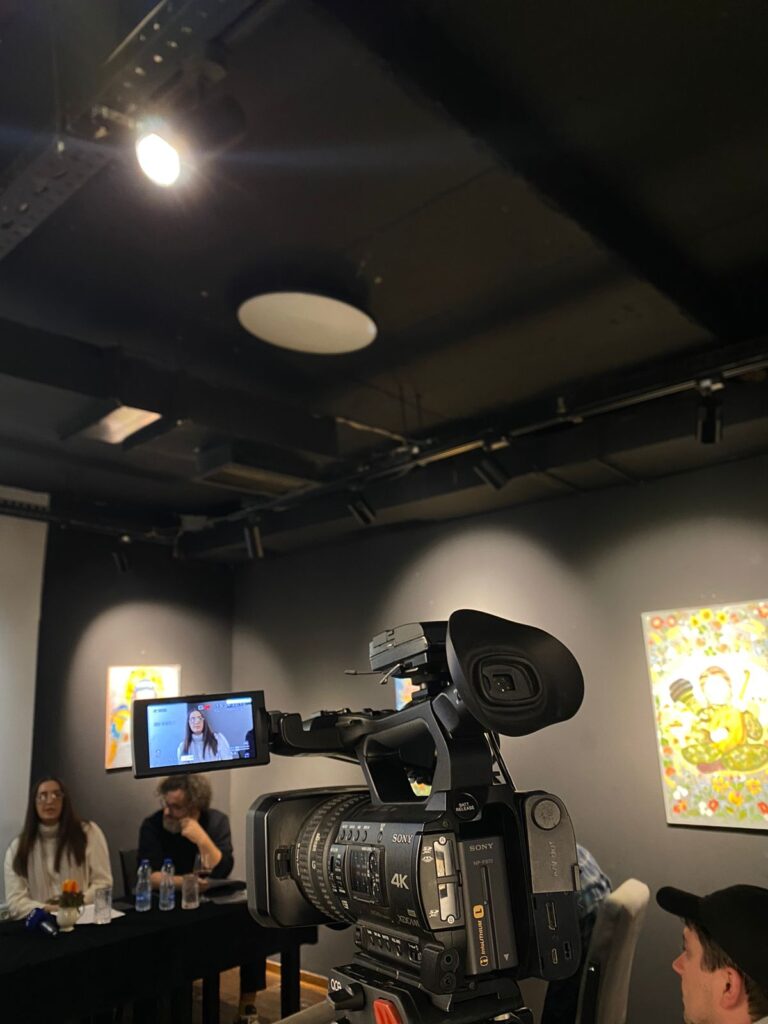
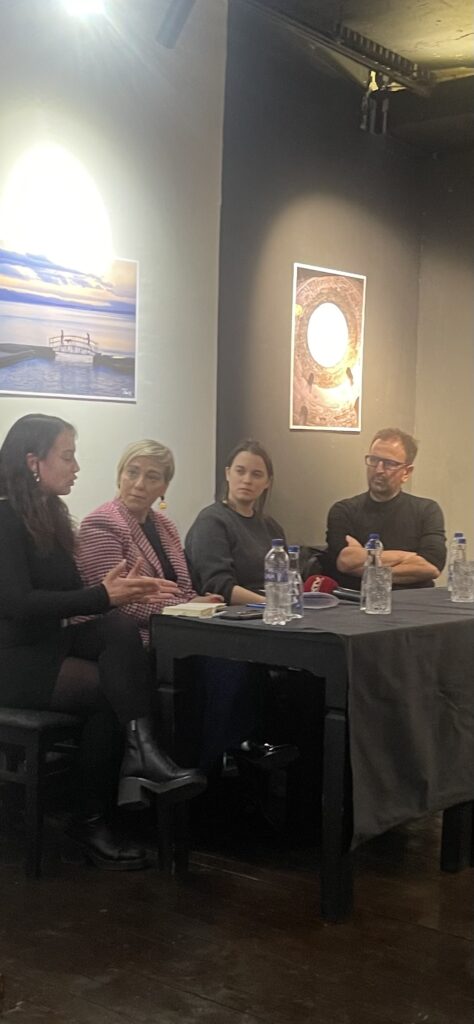
The translation was done as part of the course “Artistic Critique” at Hani i 2 Robertëve.
Text mentor and editor: Shkëlzen Maliqi
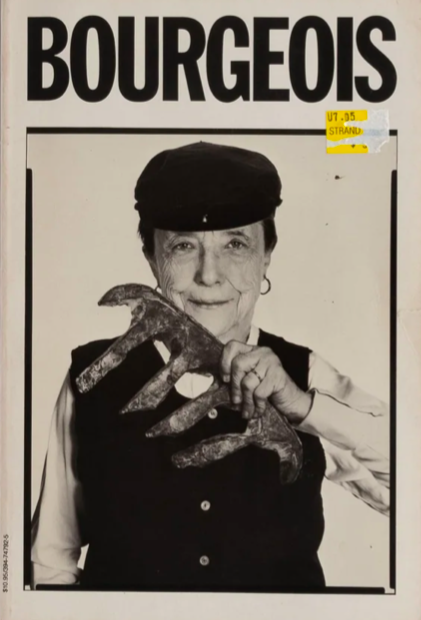
Louise Bourgeois: I knew the Surrealists socially. They were my elders. Marcel Duchamp could have been my father. The Surrealists had a gallery called Gradiva, which was near the building where I lived. I saw them everyday after lunch, when I was a student. They were of course famous artists. They were father figures...
Donald Kuspit: Do you feel an affinity with their ideas, with the notion of the work of art as a kind of manufactured dream?
LB: I have never mentioned the word dream in discussing my art, while they talked about the dream all the time. I don't dream. You might say I work under a spell; I truly the spell. I have the privilege of being able to enter the spell, to enter this very arid land where you are likely to find your birthright. To express yourself is your birthright. In the spell I can express myself…
First, I work on a drawing, then I translate the concept into cardboard, and later into corrugated cardboard. Let me explain how it happens. I get hooked on a subject and make sketches and drawings. That’s how the obsession begins, lasting for several months. Then it disappears, only to reappear a few years later. I am involved in a kind of spiral, a spiraling motion of motivation. The material itself—stone or wood—does not interest me as such. It is merely a tool; it is not the goal. You don’t make a sculpture because you like wood. That is absurd. You make a sculpture because wood allows you to express something that another material would not allow you to.
DK: It seems that you move from sketches to a cardboard model, then to a corrugated cardboard model, and then to wood and stone. And you apparently feel free to stop at any point in the process, and dig into that material, to linger with it and work with it. Is that correct?
LB: Yes
DK: In other words, sometimes the sculpture is completed at the wood stage, and sometimes at the stone stage.
LB: That is true. But at each stage, it is a sculpture. Every piece of the series belongs to the whole, from the smallest sketch to the marble.
DK: But it seems you prefer marble. It looks as though you like the harder material, the material with more resistance.
LB: Yes, I would say that. I think I express myself better in marble. It allows you to say certain things that clearly cannot be said in other materials.
DK: What kind of things?
LB: Persistence, repetition—those things that push you toward endurance, that compel you to be persistent. I am a persistent person.
DK: I am aware of that.
LB: Art comes from life. Art is comes from the problem you have in seducing birds, men, snakes—anything you want. It’s like in a Corneille tragedy, where everyone pursues someone else. You like A, A likes D, and D likes… As a daughter of Voltaire and as someone educated in the rationalists of the eighteenth century, I believe that if you work hard enough, the world will become better. If I work with dedication and persistence in all of this… in the end, I will achieve what I aim for…
LB: I observe the cube I’ve been studying for a long time. Then I try to express what I have to say, to give form to what is inside me. I try to carve my sorrows into stone. The carving process begins by denying the stone’s stability. The challenge is how to carry that denial to the end, how to remove something from the stone without completely destroying it, yet surpassing it, conquering it. The cube no longer exists as a pure form for observation; it transforms into an image. I appropriate it with my imagination, with my life force. I put it in the service of my unconscious…
DK: Let’s talk a little about your current status in the art world in New York. You must be aware that you have become an important symbol for many New York artists. You are an older artist who has finally received serious recognition, after great persistence. Your perseverance, as you call it, has borne fruit. And you are a female artist, which makes your success even more significant, even more necessary for feminists. For many people, you are a beacon of hope in a dark, difficult, and male-dominated art world.
LB: I am completely unaware of that, of any of it.
DK: Of course, you must be aware of your struggle to be recognized; you must have some feelings about this. You must remember the crowds of women artists who came to the opening of your retrospective at the Museum of Modern Art, to honor you. You have become a symbol like Georgia O’Keeffe. Your work has been called a “gathering point” for feminist artists. Even if you are not conscious of this, how do you respond to this idea? Are you a feminist? What do you think about feminism in the art world? How do you respond to the idea that you are an important woman artist?
LB: Well, I don’t think it’s particularly flattering… My feminism is expressed through a deep interest in what women do. But I am a complete loner. Being around people doesn’t help me; it really doesn’t. What helps me is to understand my own shortcomings and expose them. Another very sad statement is that, in truth, I only like people who help me. It’s a very, very sad statement.
DK: But don’t you think there is a particular prejudice against women artists?
LB: No. Many artists have been ignored. That’s the problem. Being ignored is not the same as being discriminated against. I don’t think many are discriminated against, but many are, without a doubt, certainly ignored. It’s part of human nature, the fact that man is a wolf to man; it’s part of the way man is a wolf to man.
DK: So, you really weren’t interested in success?
LB: No, I wasn’t. That’s why I’ve lasted so long. Success has accompanied me, but it was never the goal of my work. My work will outlive success itself; it will be more enduring and stronger than success. I have never felt disappointed by a lack of success. That’s why I’ve never destroyed any of my pieces. Many artists destroy their works, not because they are bad, but because they haven’t succeeded—because others weren’t interested in them, because others didn’t pay attention. When dealers finally began to seek me out, when they finally came to me, all my works were still there. They were on my shelves. I admit that now I take better care of them than before. I used to just leave them, untouched, collecting dust. I have a somewhat cannibalistic approach to my works. I let them sit until I could use them to create something new. They had to reach a certain state of familiarity and understanding. Only then could I incorporate them into a new work. I had already worked on them, and this prepared me to continue working, having assimilated, having “digested” what I myself had made…
DK: What do you think about modern art in general, if you were to speak broadly? How do you see yourself within the history of modern art?
LB: I’m not interested in the history of art, in the academic rules of styles, or in the series of trends that come and go. Art has nothing to do with art. Art has to do with life, and that encompasses everything. This comment is addressed to all those art academics who have tried to extract the art of the late ’80s from the study of art history, which, in truth, has nothing to do with art. It’s about appropriation. It’s about the attempt to prove that you can do better than someone else, and that a famous art history professor is superior to an ordinary artist. If you are a historian, you should have the dignity of a historian. You don’t need to prove that you are better than the artist.
LB: But I can say this. I studied in Paris in the 1930s, at a time when artists had studios that were open to students. My favorite teachers, among many others, were Fernand Léger, Othon Friesz, and Paul Colin. Michel Leiris and André Breton were also part of my formation. I have also taught for a long time and have been awarded many honorary doctorates. As flattering as these are, they have little connection to my ongoing way of expression. I also value my friendships with Le Corbusier, Duchamp, Miró, Arp, Brancusi, Franz Kline, and Warhol. Today, I cherish my friendships with Robert Mapplethorpe and Gary Indiana.
DK: Which artists do you like the most?
LB: I like Francis Bacon the most, because Bacon has terrible problems, and he knows he will not solve them, but he also knows that he can survive them every day and stay alive. He does this because his work gives him a kind of light, a jolt of energy. And also, Bacon is not satisfied with himself. Some people might say, “What do you mean by that? He always paints the same painting.” That is true — he always paints the same painting, because he is driven by something internal. But he is never satisfied with himself. Never.
DK: Beyond your personal history with modern artists, what does modern art mean to you in itself?
LB: Modern art means constantly searching for new ways to express yourself, to express your problems, because there are no stable methods or predetermined approaches. It is a painful condition, and modern art speaks precisely to this pain: the lack of a secure way to express oneself. This is why modern art will continue—because this condition persists; it is the modern condition of humanity.
DK: Do you think modern art has a special connection to the painful difficulty of self-expression in the modern world?
LB: Definitely. It has to do with the hurt of being unable to express yourself properly, to express your intimate relationships, your unconscious, and to have trust in the world around you to express yourself directly within it. It’s about the effort to be lucid in this situation, to be momentarily and cautiously lucid, through self-expression. Every work of art is born from the painful experiences of failures and from the needs that push us to express ourselves. It concerns the difficulty of being oneself in a world that ignores you. Everywhere in the modern world there is neglect, and the desire to be recognized remains unfulfilled. Art is a way of knowing oneself, and that is why it will always be modern.
Translated and adapted into Albanian by: Elmedina Salihu
Student of the Faculty of Arts

The blog was published with the financial support of the European Union as part of the project “The development of art criticism”. Its contents are the sole responsibility of Hani i 2 Robertëve and do not necessarily reflect the views of the European Union.