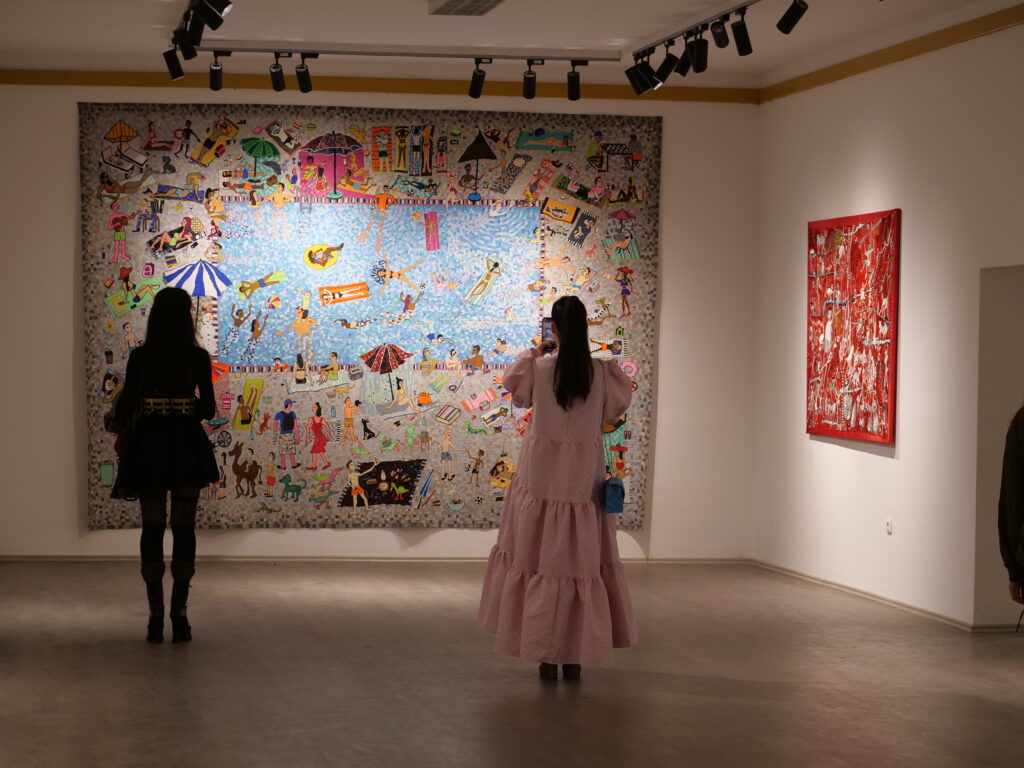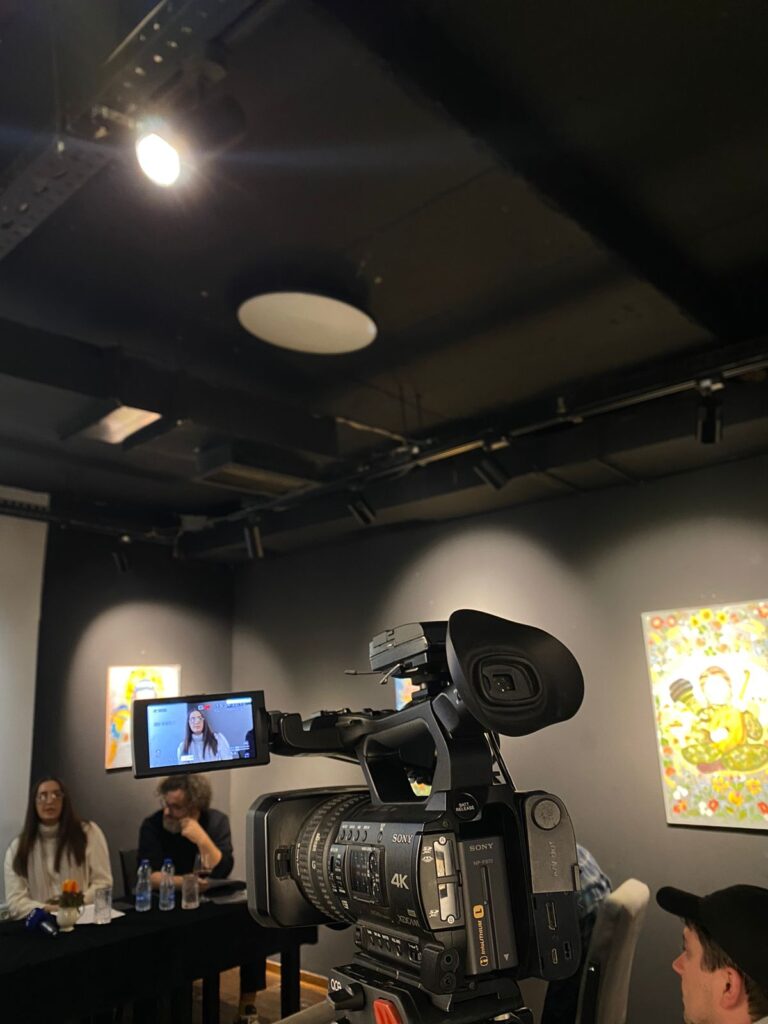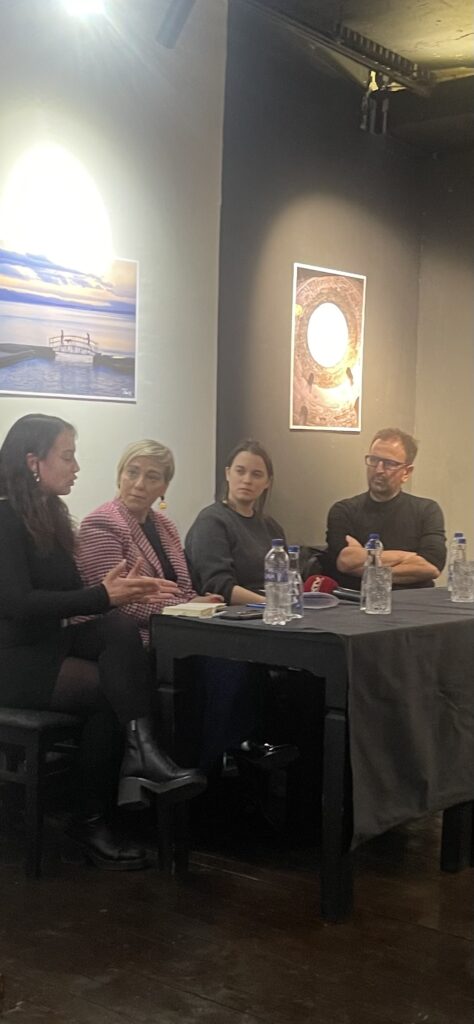
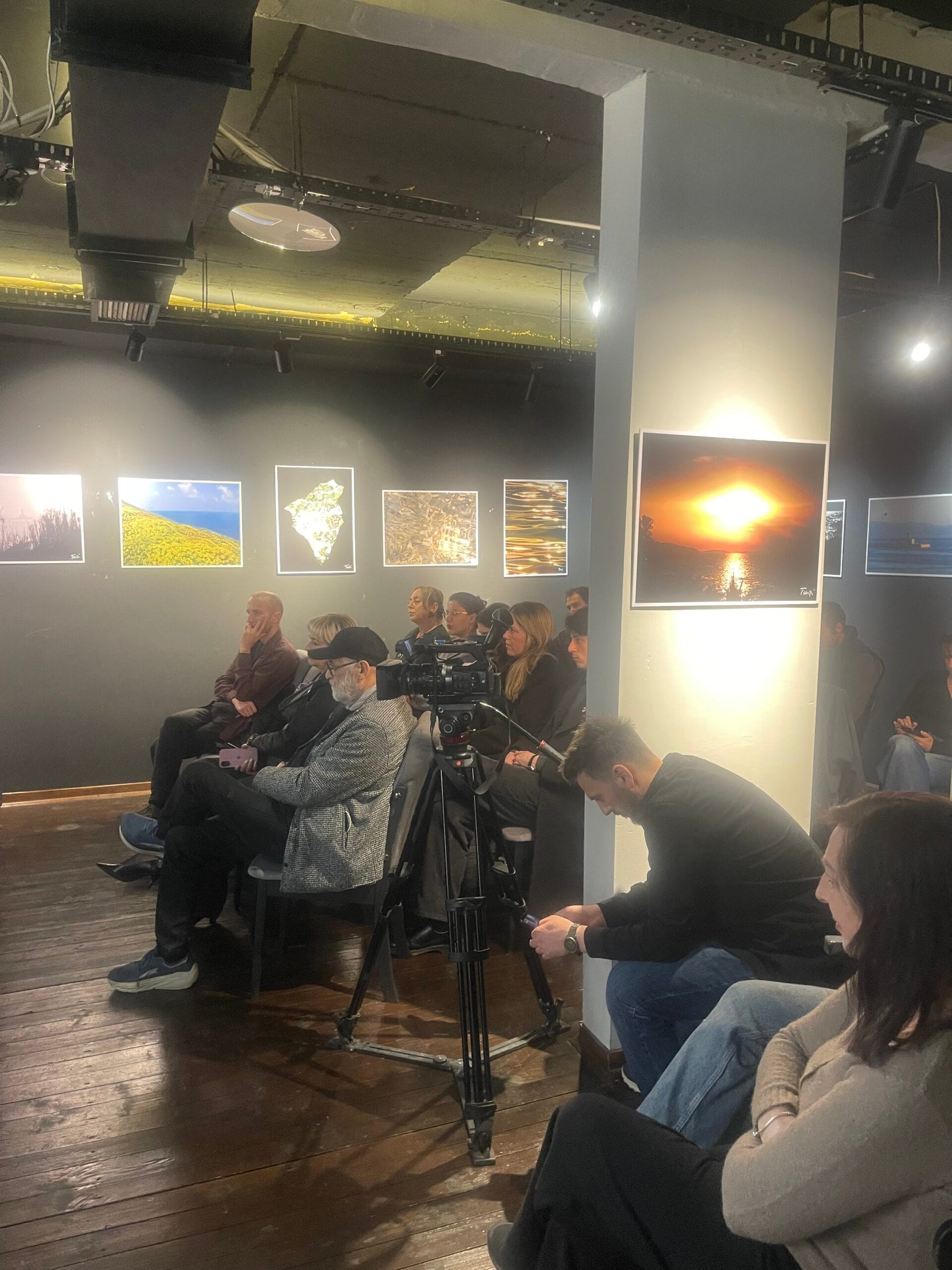
On March 11, 2026, the panel discussion titled “Public Culture and Independent Culture” was held at Hani i 2 Robertëve, moderated by Diona Kusari with the participation of Director of Culture in the Municipality of Prishtina, Sibel Halimi, director of Kino Armata, Rozafa Maliqi, and director of Qendra Multimedia, Jeton Neziraj.
The discussion broadly focused on the relationship between public culture and independent culture, whether we have achieved a fair and equal model of support for both sectors, and how public culture could be reformed through greater programmatic and financial autonomy.
In the Kosovar cultural scene, the main actors are: public institutions, which represent a form of stoic stability; independent initiatives, which represent more innovation and novelty; and community spaces, which are focused on and built through civic participation. What we refer to as independent culture and public culture are two ecosystems that differ in terms of funding models, infrastructure, and governance logic. The independent scene is often characterized by the appropriation of public spaces through self-initiative or community initiative, decision-making autonomy, non-commercial practices and a critical positioning toward the state. The tensions between the two typically stem from: public funding versus short-term project-based grants, institutional stability versus flexibility, professionalism versus community-driven initiative that develops organically and bottom-up, and control versus freedom in management and programming.
In Kosovo and the capital city more precisely, key issues between these two ecosystems in recent times have been: the question of who has access to public spaces and the need for a clear database and regulation for the use of public spaces; political bottlenecks that have prevented the transfer of funds from the central level to the local level, thus to different actors; the need for sustainability and status recognition of experienced initiatives and organizations; and the lack of recognition of informal initiatives. Whether these two ecosystems are competitive, complementary, or structurally unequal remains an open question. What is clear is that public institutions have a guaranteed basic infrastructure and stable funding, while independent actors are forced, with very limited staff, to act as producers, administrators, creators, and managers, and remain dependent on external funding if they want to grow, a yet again unsustainable model for preservation.
During the discussion, the need for greater autonomy of independent cultural initiatives was emphasized, along with serious and dignified infrastructure and the maintenance of existing initiatives that have already proven their value. On one hand, the focus of this mandate has been the creation of new spaces funded by the Municipality to increase capacities for artists and cultural workers in the capital. The new Cultural Strategy 2026–2031, as stated by Sibel Halimi, was informed directly by the community through the participation of 300 artists. On the other hand, independent scene actors emphasize that they do not have sufficient support for the spaces they manage and the continued need for programmatic autonomy.
The debate showed that the boundary between public and independent culture is becoming increasingly blurred. Institutions are becoming more open to collaboration, while the independent scene seeks structural support, not only symbolic recognition. History shows that progress has largely come from the persistence of artists and independent organizations themselves.
The Director of Culture in the Municipality of Prishtina stated that she sees public and independent culture as closely linked, as there are institutional mechanisms that regulate their relationship. Although politics often instrumentalizes art and culture, she argued that the role of institutions is to create funding, infrastructure, recognition and legitimization of cultural diversity. “Institutions must adapt themselves in relation to independent art,” she said. “At the same time, there is a certain ambiguity in defining independent culture or the independent art scene, as it is presumed that when a public institution funds a space or initiative, it must also be involved in it.” she added.
For her, the focus of this mandate has been the creation of physical spaces for artists. Though the funding support is typically small, she emphasized that the municipality has introduced successful models where spaces are funded by the municipality and managed by artists, something that does not happen in other municipalities, with existing examples such as the cultural center in Llukar managed by Stereospace. Among the new achievements of the Department of Culture, she mentioned the revitalization of two bunkers in Ulpiana into cultural centers, the creation of the City Orchestra, the Modern Ballet, and the Prishtina Art Gallery at the Palace of Youth. In addition, she mentioned future plans to turn the Hertica House-School into a museum, a new cultural center at the “Ramiz Sadiku” school in Marec, and the space given to Artpolis at the Train Station. She claimed her focus to be cultural decentralization, namely creating cultural spaces in the outskirts of Prishtina, developing new spaces in Prishtina, and establishing more horizontal relationships with cultural workers.
The Center for Narrative Practice (CNP), formerly the Hivzi Sylejmani Library at Qafa neighborhood, is an interesting case in this context, part of the legacy of Manifesta 14. One year after Manifesta concluded, the space was left behind and used for municipal administrative purposes but through advocacy by a local group of cultural workers, i.e. Workers in Art (PART), the envisioning of its open and public use was handed to a commission composed of the Municipality and PART members. Through this, a participatory model is being developed for the future use and management of the space, with criteria and decisions informed by open and public discussions.
Rozafa Maliqi emphasized the precarity and burden of self-management carried by independent organizations, as well as the daily maintenance needs of physical spaces. According to her, these spaces produce the majority of cultural content in the city, but spend most of their energy ensuring basic survival rather than focusing on artistic programming. She stated that there is still a strong need for formal institutional support, recognition of existing work, and clear municipal mechanisms that help these spaces with regards to bureaucratic procedures, funding, and sustainable use of public assets. “There is a need for more recognition of the work we do, instead of spending so much energy on readdressing these same issues. We end up doing a lot of work just to improve the conditions for continuing the work we are already doing,” she said.
Jeton Neziraj argued that the division between public and independent culture has long been ideological. The independent scene was once viewed with suspicion as “private” or foreign-donor linked, while today it has proven to be more dynamic, innovative, and often more vibrant, identifying up-to-date topics and contemporary aesthetics faster than public institutions, which are burdened by bureaucracy and less adaptable. “The cultural scene was demonized for a long time here, and it only later became a factor, when foreign media arrived and local production began to be exported. Only then did the state start to change its approach,” he said. He noted that public institutions are now adopting practices from the independent scene. According to him, the successes of independent culture are not institutional gifts but the result of pressure and many years of advocacy by cultural actors themselves.
He emphasized that in the Netherlands, 80% of the theater budget is allocated to independent theaters, and that here as well there should not be such a barrier that public institutions are funded first and whatever remains goes to independent actors, but rather a more proportional support based on cultural work and value generated. Regarding Kosovo’s independent cultural scene, he stated that nothing was offered to it but that it was self-created. He mentioned that in Peja, the cultural organization Anibar plays a greater role in public culture than any municipal initiative, and that even for the Oda Theatre, basic expenses were only recently covered by the municipality after many years of pressure—expenses that are basic, while real costs and ambitions are much larger.
He also noted that as director of Multimedia, although their shows are currently being held at the National Theatre, the current space is still not dignified, and that renovations of the Oda Theatre, their homebase institution, will take much time.
During the discussion, the newly introduced mechanism of institutional grants from the Ministry of Culture, Youth and Sports were also mentioned, which seems to have increased programmatic support for independent institutions. However, Jeton stated that these grants have only enabled survival. Among independent scene panelists, it is clear that the local public institutions respond slowly to the real needs of independent actors or even recognize and provide institutional support, contributing to a culture where an independent actor is not acknowledged locally without external validation. One example is Termokiss, which for nearly 10 years has been maintained mainly through volunteer work. Decentralized, yet sustained advocacy and daily work by independent actors has maintained the scene for a long time.
Diona Kusari

Multidisciplinary artist, writer, researcher, and cultural mediator based in Kosovo. Her work focuses on materializing the invisible, whether it be belief or ideology, as well as challenging the assumed divide between the private and the public. She works within horizontally organized collectives, such as Potpuri, which focuses on self-publishing practices and the self-production of knowledge. She writes experimental poetry, blogs, reviews, and articles that center on cultural reflection and critique, addressing the virtual and the symbolic, and theorizing around topics of so-called public interest.
The blog was published with the financial support of the Swiss Agency for Development and Cooperation (SDC) as part of the project “Empowering Cultural Expression.” Its contents are the sole responsibility of Hani i 2 Robertëve and do not necessarily reflect the views of the Swiss Agency for Development and Cooperation.