
The Premises of Happiness
She wakes each day within a life she does not openly reject, yet one her body can no longer conceal. Love is there. The home is there. The child is there. Everything is in its proper place, everything functioning as it should. And yet, something within her remains inexpressible, a low hum that never ceases. An absence attached to nothing concrete, yet permeating everything.
This is not the story of a woman who does not know how to love, but of a woman who does not know how to live within the form of love that is offered to her. Her psychological state demands neither moral explanation nor narrative healing. It demands attention. Like any symptom, it speaks to something larger than itself: the pressure of prescribed roles, the violence of social constructs, and the price of stability.
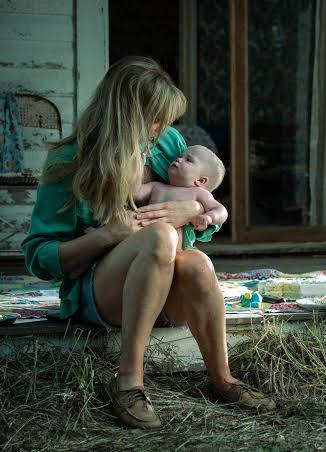
Die, My Love follows Grace (Jennifer Lawrence), a young woman who moves to a rural area with her husband, Jackson (Robert Pattinson), where he spent his childhood, as they await the birth of their first child. The film begins with fragments of happiness and intimacy, yet its color palette, and Lynne Ramsay’s previous work, signal that this will not be a romance. The outward stability of their life does not correspond to Grace’s inner state. She gradually begins to withdraw, isolate herself, and experience anxiety, emotional outbursts, and an increasingly strained relationship with her body, her sexuality, and her role as both mother and partner.
After the birth of their child, her husband's perception of her changes in a way that is subtle yet decisive. Grace’s body is no longer read as a site of desire, but as a functional body: a mother, a caregiver, a guarantor of stability. This transformation is never articulated directly; it manifests through physical distance and intimate rejection. Grace shifts from being an object of desire to serving a symbolic function. Eroticism is excluded from the relationship, not through an overt act of violence, but as an unwritten rule. The rejection is not personal; it is structural. It belongs to an order in which motherhood excludes sexuality, and where a woman, once she becomes a mother, ceases to be desirable.
The female character in Die, My Love is not constructed as an unstable figure that needs correction. She is not “unstable,” because instability implies a deviation from the norm. Here, it is the norm itself that becomes unbearable. Marriage, motherhood, love, forms that promise calm, appear as closed structures within which the female subject begins to lose her desiring dimension. The body becomes excessive, noisy, dangerous. Not because it is out of control, but because it refuses to remain regulated, readable, and useful. In this refusal, she does not become mad but becomes a symptom.
Intimacy as a structure of control
The relationship is constructed as a structure of emotional power, where one partner carries the weight of stability and the other attempts to survive it. The husband is not presented as a classical antagonist. He functions “as he should”: present, rational, restrained. It is precisely this alignment with the norm that makes the relationship inescapable and, for the female subject, lethal. She is not destroying the family; she is being destroyed by its form.
Intimate refusal does not occur through open conflict, but through continuous deferral: exhaustion, lack of time, the need for calm. Her body is not met with prohibition, but with absence of response. This absence functions as a mechanism of power: her desire begins to appear excessive, inappropriate, while the structure of the relationship remains intact. Desire does not disappear; it becomes radicalized.
Desire beyond form
When the symbolic order fails, the film shifts toward the body. In Die, My Love, the body becomes the site where what can no longer be processed through language, love, or role is exposed. Sexual impulses, aggression, and sudden acts are not narrative provocation, but signs of a conflict that has slipped beyond symbolic control.
Here, Thanatos emerges not as a desire for death, but as existential exhaustion, as a refusal to continue functioning. When Eros can no longer bind, Thanatos intervenes to sever. The body becomes dangerous because it refuses to be useful: it no longer produces meaning, but intensity.
In this context, the scenes in which Grace harms herself do not function as signs of a desire for self-annihilation, but as extreme forms of what Georges Bataille describes as erotism bound to death. For Bataille, eroticism is always a transgression of the boundaries of the regulated and utilitarian body; an experience that brings the subject closer to loss, danger, and sacrifice.
The injury to the body can be read as a kind of unconscious punishment of desire, not because it is “wrong,” but because it has become uncontainable within the order that excludes it. The body is not destroyed in order to disappear, but to break the limits of an existence that demands calm, function, and restraint. In this sense, violence is not directed against life itself, but against the form of life that has been offered to it.
But this erupting body does not exist in a vacuum: it is shaped, constrained, and managed within structures that define this eruption as deviance.
The female body as a political space
In Die, My Love, the female body does not function as a private territory, but as a political space onto which the expectations of the social order are inscribed. Marriage, motherhood, and love are not merely intimate structures; they are mechanisms for managing the female body, desire, and intensity. Grace’s body does not belong solely to herself; it belongs to the stability that must be maintained.
The scenes in which she harms herself or pushes her body toward destruction cannot be read as acts of individual pathology. They function as political gestures, because they occur precisely at the point where the female body has lost the right to be desiring, unstable, and unuseful. Self-harm appears as a response to an order that demands the female body to be functional without being alive, and calm without being free.
In this sense, Grace’s body becomes an altar of the social order. It bears the burden of familial stability, the emotional calm of the other, and the symbolic continuity of life. Female sacrifice is neither heroic nor articulated; it is silent, normalized, and expected. The body is allowed to be damaged as long as the structure remains standing.
By harming her body, Grace is not destroying the order, but rendering it visible. Violence does not come from the outside; rather, it is internalized as a discipline of desire. The body is punished for its own excess, for its inability to fully adapt to the role of the calm mother, the understanding wife, and the stable partner. This is the politics of the female body: it is managed, constrained, and, when it refuses to comply, sacrificed.
In Die, My Love, the refusal to be a useful body becomes a subversive act. The body no longer produces moral meaning or narrative reconciliation; it produces disturbance. It is precisely this disturbance that renders Grace’s figure political. She does not seek to reclaim the body as individual autonomy, but instead exposes the fact that autonomy has always been conditioned. Her body is not liberated; it resists by becoming unbearable to the order that demands its calmness.
The woman as an epistemic threat
The female figure in Die, My Love belongs to an increasingly visible strand in contemporary cinema: the woman who no longer seeks to be understood or saved. She is not articulated as a classical victim, because she does not ask for empathy; nor is she an emancipatory figure in the traditional sense, because she offers no model, exit, or lesson. Her presence is unsettling precisely because she refuses to function as a moral sign. She does not explain herself and does not ask forgiveness for her condition.
The risk this figure represents is not tied to her potential violence, but to the absence of meaning she produces. She does not channel conflict toward a clear enemy, nor does she displace it outside herself. Instead, she sustains tension as a condition, unresolved, unexplained, and continuous. This distinguishes her from the classical femme fatale, who in traditional cinema is constructed through sexuality as a threat to the male order and who is ultimately neutralized or punished.
The woman in Die, My Love is the descendant of this figure, yet undone by the logic of narrative. She does not manipulate, does not seduce strategically, and does not exercise power over others. Her threat is not active but structural. She does not attack the order; she refuses to function within it. It is not her desire that is threatening, but the fact that this desire no longer finds an acceptable form of expression.
In the post-MeToo context, this figure emerges as a response to narratives that demand healing, integration, and a return to normality. Unlike stories that center trauma as something to be processed and overcome, Die, My Love refuses the idea of repair. The woman does not “learn” or arrive at a new equilibrium. She does not become a better version of herself. This refusal to offer closure is essential: the film does not propose solutions, because the very demand for solutions is part of the violence it exposes.
In this sense, Grace’s figure is not dangerous because she might destroy the family, but because she makes visible the limits of the forms through which we know how to tell stories about women. She is not a metaphor of hope, nor of sacrifice, nor of emotional resilience. She offers no compensatory narrative. Therefore, the risk she represents is not destructive in the classical sense, but epistemic: she puts into crisis the very ways in which we understand the female subject, desire, and normality.
In Die, My Love, this figure is not positioned as an exception, but as a cultural symptom. It signals that contemporary cinema is beginning to accommodate female subjects who are no longer moral projections, but sites of unresolved conflict. And it is precisely in this lack of reconciliation and full intelligibility that its political and aesthetic force resides.
Dhurata Hoti

Dhurata Hoti is a writer, playwright, and screenwriter from Kosovo.
The blog was published with the financial support of the Swiss Agency for Development and Cooperation (SDC) as part of the project “Empowering Cultural Expression.” Its contents are the sole responsibility of Hani i 2 Robertëve and do not necessarily reflect the views of the Swiss Agency for Development and Cooperation.