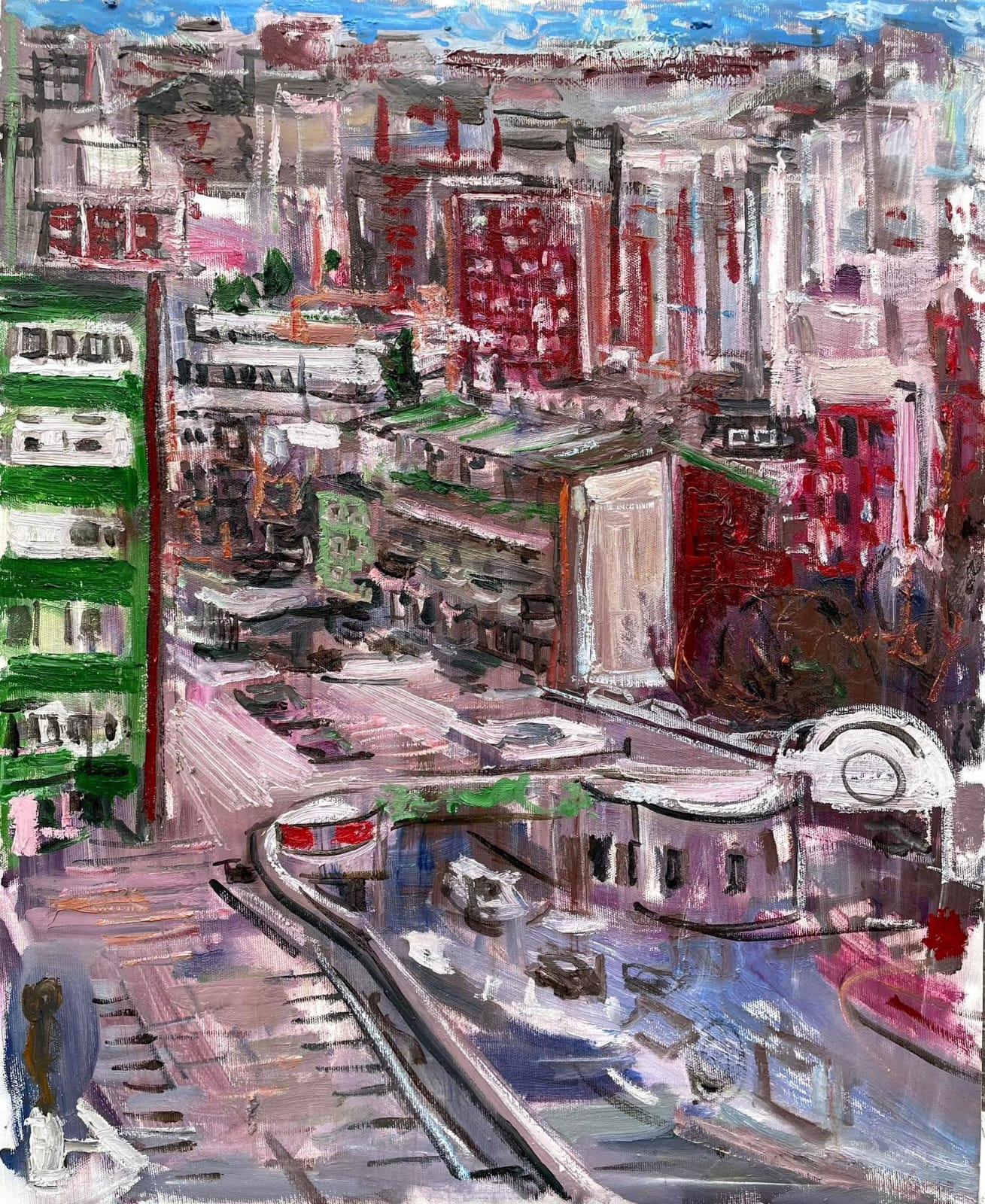
Rron Qena is the most urban-centric artist of the generation of post-war Kosovar artists. His worldview, inspirations, motifs, approach, and even the angles of the images he creates come from the everyday reality of the urban spheres that define and surround his life.
Qena has a neo romantic approach to the contemporary city. He views Prishtina, his birthplace where he completed his art studies and which he has made an almost constant subject of his paintings, as well as Bremen where he has lived in recent years, with a sympathetic, affirming, even “embellishing” eye.
Prishtina, without a doubt, appears appealing in the artist’s paintings, thanks to his talent and mastery in “portraying” the capital of Kosovo. Nevertheless, there are also other experiences of Prishtina, and art does not have the duty to satisfy every perspective, for example to express concern about the trend of Prishtina’s chaotic development, the planned and unplanned constructions that swallow up the already scarce public spaces.
In his work, elements of chaos in the city can be observed, but he is more interested in the constant of city panoramas with hills, once even with two small rivers that today have been channeled underground. Further on, Qena abstracts the crowds of people and the traffic of cars that barely move through dehumanized environments. Even from neighborhoods of concrete, steel, and aluminum buildings, what enters his work more strongly are the reflections of hundreds of windows, where the pulses of urban life appear, essentially artificial, yet which he turns into expressive notes in his painterly symphonies.
Since the time of Romanticism, and even today, artists have experienced the modern city as alienating and corrupting natural life. The chaos and constant buzz of today’s cities are truly exhausting and suffocating. Salvation has often been sought in a return to natural living. Gauguin did this by leaving and painting exotic Polynesia.
Qena is not concerned with the city, alienated from nature. She tends to find the natural and the exotic within the city. This gives her work a spirit of classical romanticism. Someone might say that she creates attractive postcards, while the reality of modern cities is full of gloom. But the question is: is there anything wrong with turning gloom into beauty?
Qena’s approach is not deceitful. He ennobles the city’s scenes with subtle interventions and accents, not so much in composition as in the colors and pulsating glazes that transform the everyday banality of parked cars, building facades, squares, white domes, or the light-reflecting ironwork of the National Library. Through these elements, Qena invites us to see the city differently, as a delicate revelation.
If looked at closely, Qena’s works do not neglect nature in favor of concrete. He finds living nature present everywhere: in paintings with trees, in gardens, in pots on balconies, in oleanders along building walls. In his latest paintings, Qena places large flower buds abundantly, almost entirely covering the view of the concreted city. This is not a wishful image of the city arranged as a “flower garden,” but rather a conceptual and stylistic turn in Rron Qena’s art. These flower paintings do not only enhance expressiveness, they are almost abstract. Or perhaps Qena is responding to the anti-romantics who see the city only as gloom:
Fill your balconies with flowers and your walls with art.
Shkëlzen Maliqi
This blog was published with the financial support of the Swiss Agency for Development and Cooperation (SDC) within the framework of the project “Strengthening Cultural Expression.” The content of the article is the sole responsibility of Hani i 2 Robertëve and does not necessarily reflect the views of the Swiss Agency for Development and Cooperation.