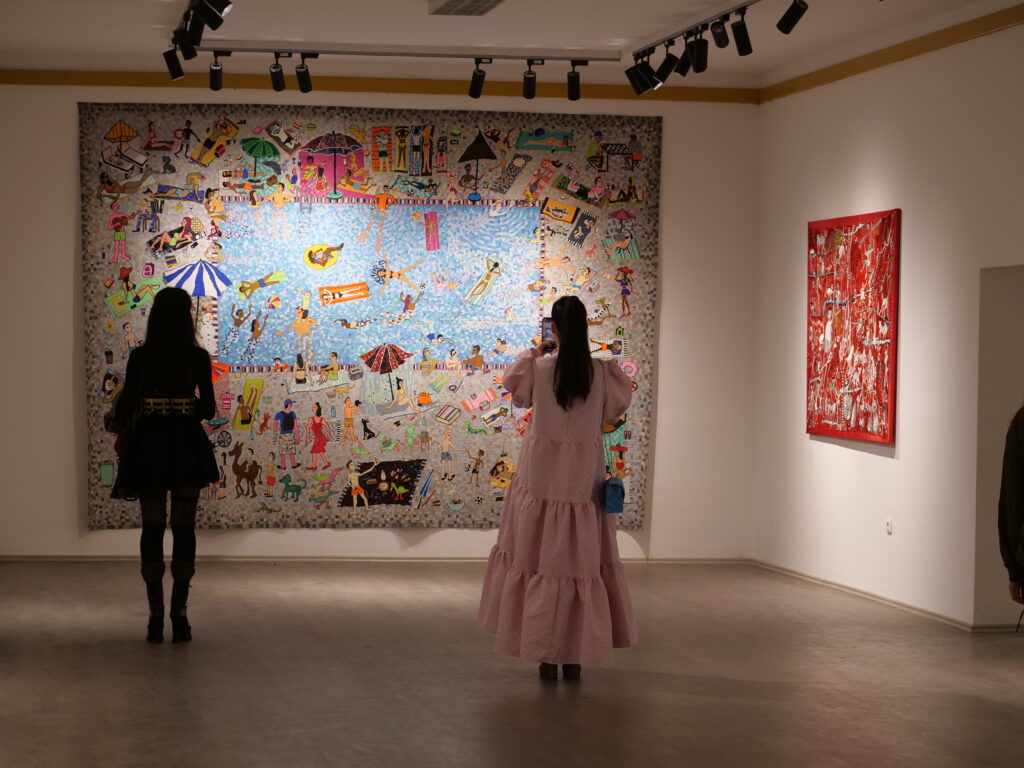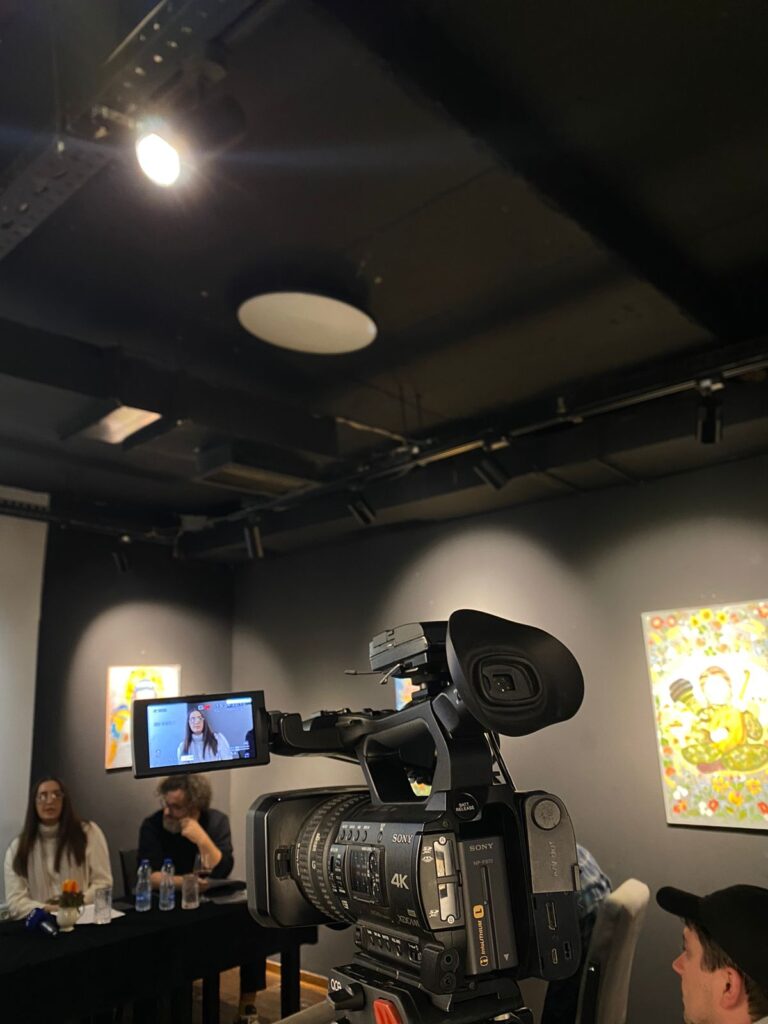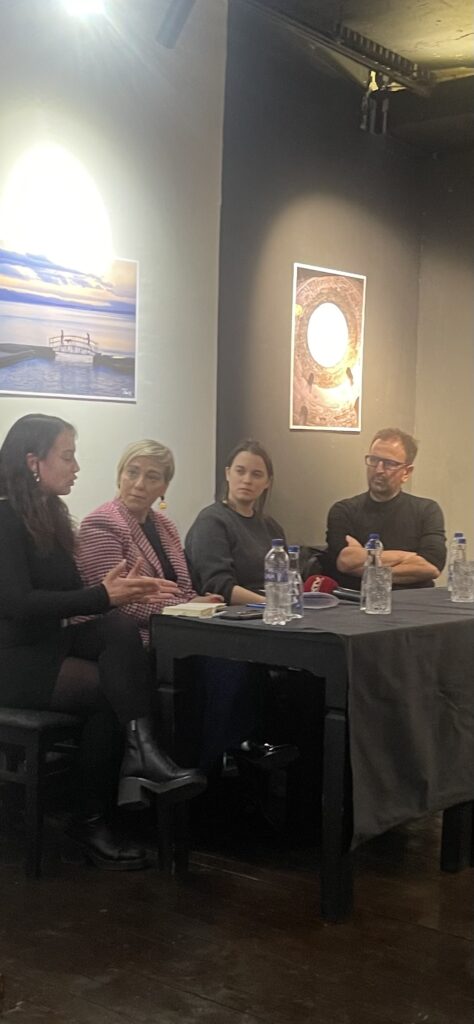
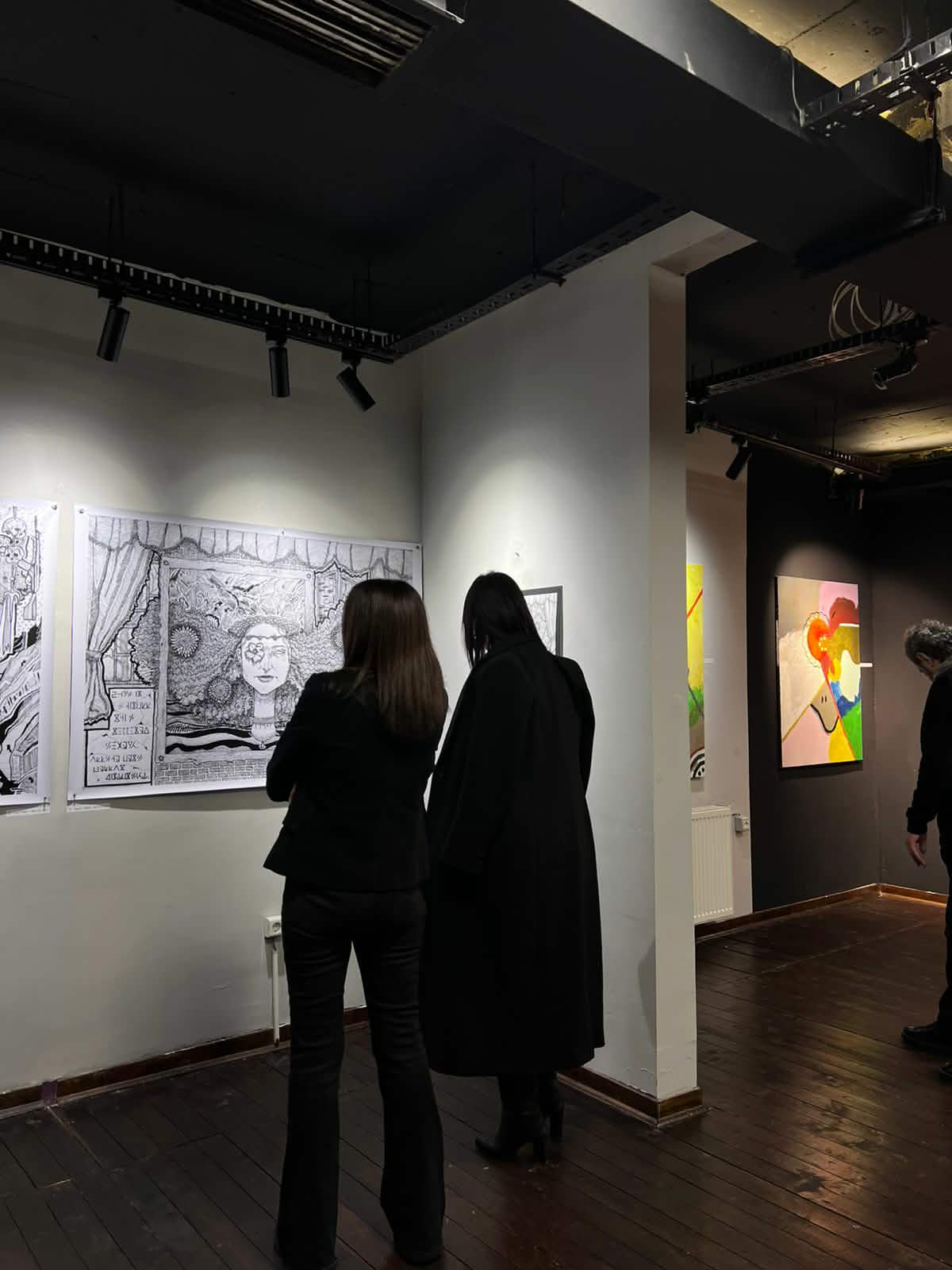
The exhibition “Cotton” by artists Manushaqe Ibrahimi and Yll Avdiu opened at Hani i 2 Robertëve on 29 January 2026. The artists’ work converse within the space, through differing practices, on the liquidity of identity and the ways in which we create meaning. Both artists work intuitively, as the artwork possesses a consciousness of its own, and so the artist appears at times as a tool for processing and at other times as the creator. Is each choice intentional or intuitive, or are both the same thing?
The works of Manushaqe Ibrahimi and Yll Avdiu shown are coming out of developed personal practices, meeting each other on the very practice of art as a personal practice of interpretation: as a means of conversing with oneself or with the subject, or as an extension of a vibrational imprint of memory and personal experiences. At the same time, a certain social crisis, an over-attachment with identification, overthinking, and the multiplicity of choices in life appears in Yll’s work as the visual language of the artwork, and in Manushaqe’s work as a point of departure.
Manushaqe Ibrahimi has been engaged in painting for nearly a decade, further developing multimedia and process-based projects through photography, film, and installation, experimenting across multiple layers, including spatial interventions and socially engaged art.
From an early age, she began developing an alphabet, a personal encoded symbolic language (cipher) which runs through her most recent series of paintings, a body of work she has been developing since 2023. She says the text in her personal cipher is the first element to appear on the canvas; the painting takes shape alongside the text. Sentences she hears from others that get stuck in her mind, as a form of message or repetitive absurdity, serve as prompts for creating a work. The alphabet will remain a continuous element in her practice until the moment someone decodes it.
The elastic and distorted figures in Manushaqe’s exhibited paintings are open-mouthed: on one hand, they seem reflective of repetitive communication and verbal exchanges driven by a need to speak incessantly, and on the other, they come off as blockages or an inability to express oneself through words. The paintings are in mutual communication with the artist, speaking through the emotional and psychological state of the time in which she created them, and in which one can observe an act of processing through other symbolic forms in place of language. Nevertheless, her language may be representative of a generation forced to internalize a normative social filter, a narrow lens that pushes to the margins those who do not express themselves in predictable manners and who reject superficial meanings.
Yll Avdiu works on drawings, illustrations, animation and digital art. His work is characterized by hatching lines and visual fragments that come together into a single piece through an intuitive flow. Yll states that lines are not merely work elements or aesthetic ones, but a manner of thinking through, reacting, and producing meaning. He says that the common language of these works, when analyzed jointly, treats identity as something flexible and relational, as a process that is both deeply personal and collaborative. As such, Yll’s works predominantly feature other individuals, often people who have been significant in his life and artistic development.
Yll’s works are characterized by a surrealist and monochromatic style, with textures and patterns inspired at times by his working spot and at other times by immediate experience, incorporating personal symbolism and references to tarot and astrology. Yll also embeds his own words as codes throughout his works, an act that demands an attentive viewer to uncover them. In Yll’s work, one can observe a need to study himself and investigate his own history, especially as he speaks on his piece “still, becoming”, one that is as intimate as it is open to observation. In this work, covered in symbolisms of his own artistic development and references to his own earlier works, self-referentiality acts as his own personal cipher. 32 eyes are “concealed” in one of his exhibited works, a number that has accompanied him throughout his life.
Both artists work in a cyclical and multilayered way, and in their practices depict an extended engagement over time with a single work, which speaks to the cyclical and non-linear nature of the creative process, and identity. In Manushaqe’s paintings, her almost-human figures do not know how to ask for help; they seek to be touched by the other but are unable to, they seek to be understood yet simultaneously do not want to mutilate themselves through expression. In this way, the coded language becomes both an internalization and reformulation of the banality of sentences, as well as a radical expression and form of resistance in which the artist retains the final word. In Yll’s works, the artist positions his gaze on the outside, primarily using others as inspiration. It seems that the density and plasticity of the unending elements in his works reveal archetypal symbols and elements of the collective (un)conscious, approached through a maximalist lens. As if the artist, whether subconsciously or intentionally, does not wish to center his work on a single subject; rather, through this gaze, he studies both the other and himself.
If there is a need for meaning where meaning must be given by oneself, in art and in life, Yll and Manushaqe find it through differing working practices, yet they meet each other on the matter of identifying with the self through fragmented life stories: stories that gain meaning through synchronicities and an intimate process in Manushaqe’s art, and through relationships and the co-creation of meaning in Yll’s works.
The title of the exhibition was chosen quite intuitively by the two artists, hinting at a recurring inside reference among them. Cotton, with its layered meaning, alludes to bodily intimacy, subtle inner-workings, revealing yet coverage-making qualities, protective measures even, and also insidious colonial violence and invisible labor. Cotton absorbs, yet its light density fills space and creates barriers seamlessly, revealing both the openness and the shield to the world, the porous symbols and meanings of life.
Written by Diona Kusari
Diona Kusari
Multidisciplinary artist, writer, researcher, and cultural mediator based in Kosovo. Her work focuses on materializing the invisible, whether it be belief or ideology, as well as challenging the assumed divide between the private and the public. She works within horizontally organized collectives, such as Potpuri, which focuses on self-publishing practices and the self-production of knowledge. She writes experimental poetry, blogs, reviews, and articles that center on cultural reflection and critique, addressing the virtual and the symbolic, and theorizing around topics of so-called public interest.
The blog was published with the financial support of the Swiss Agency for Development and Cooperation (SDC) as part of the project “Empowering Cultural Expression.” Its contents are the sole responsibility of Hani i 2 Robertëve and do not necessarily reflect the views of the Swiss Agency for Development and Cooperation.