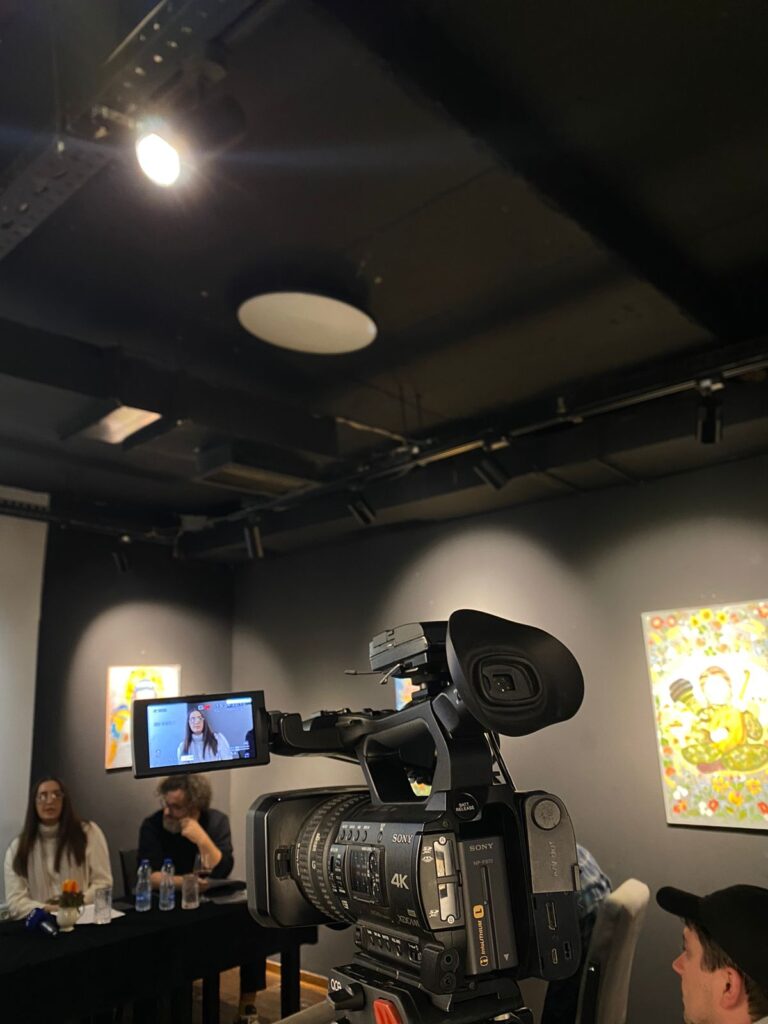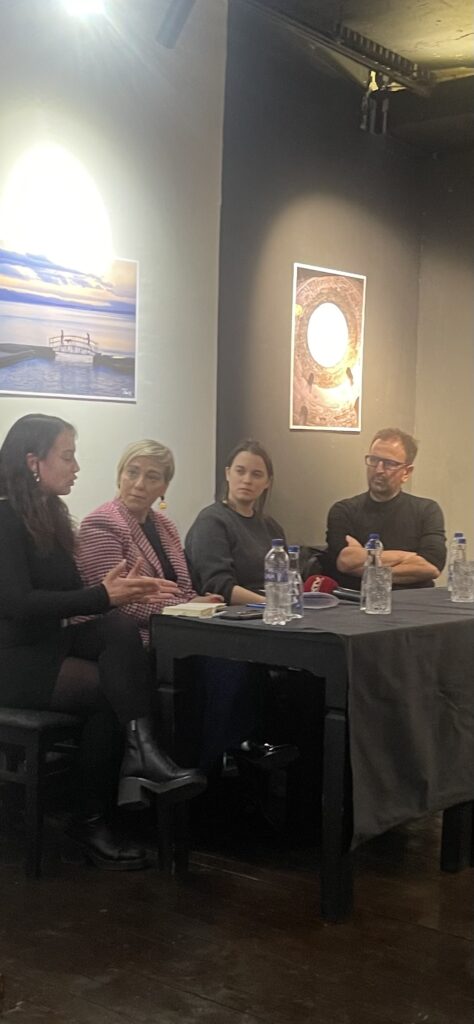
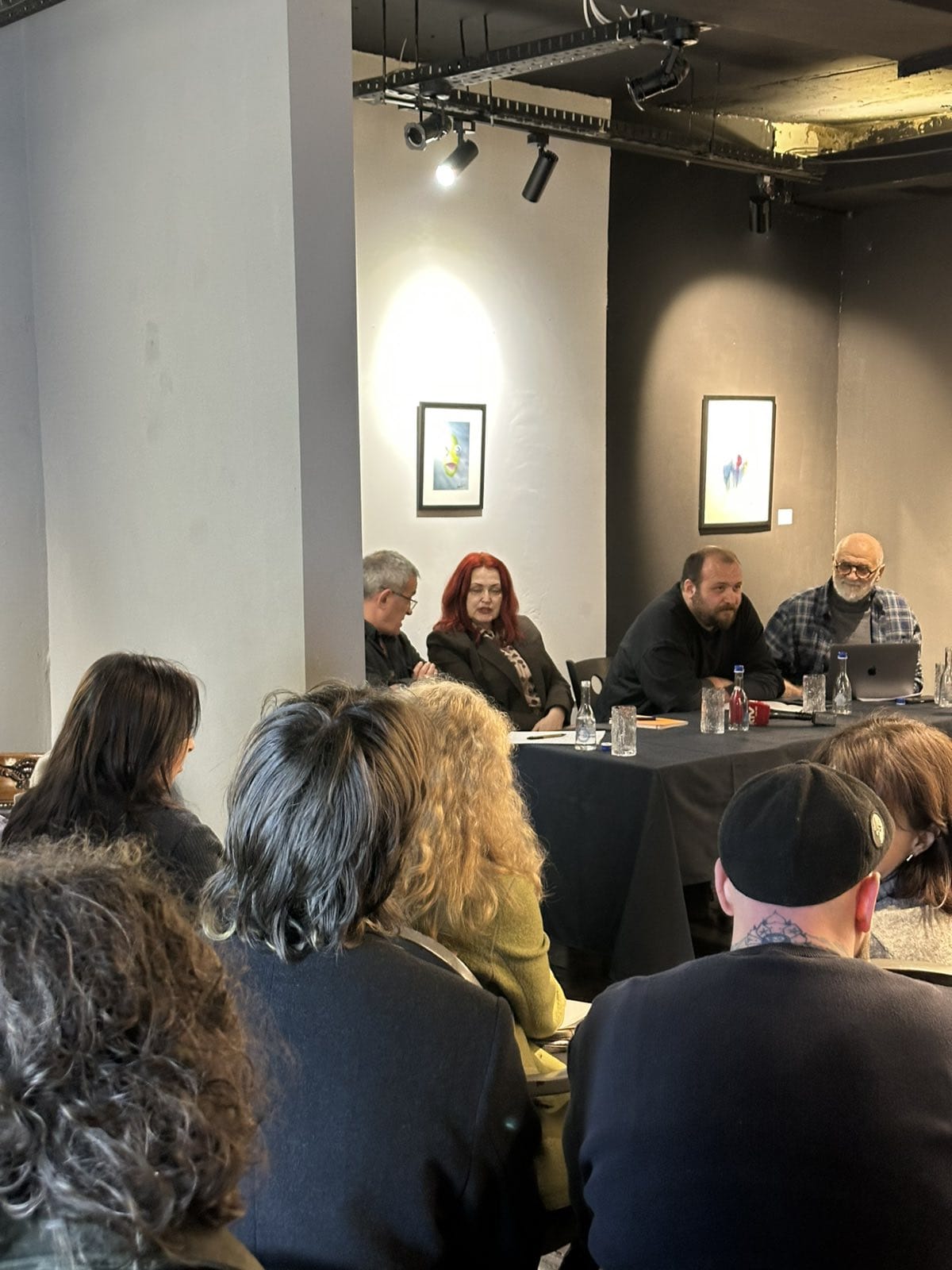
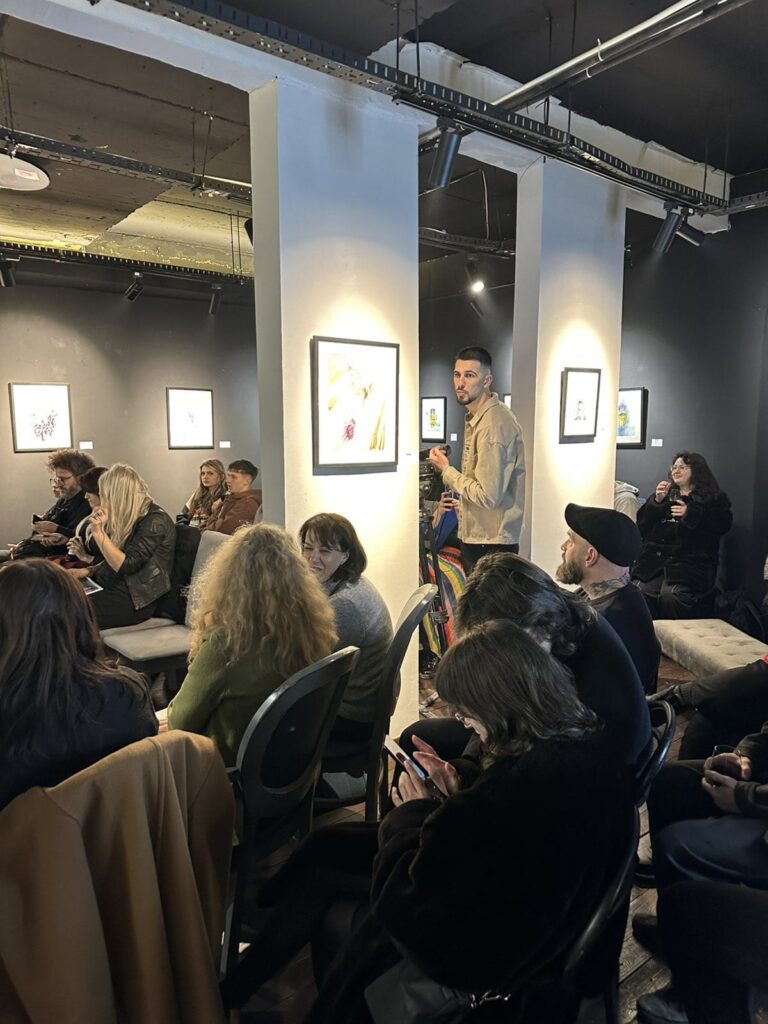
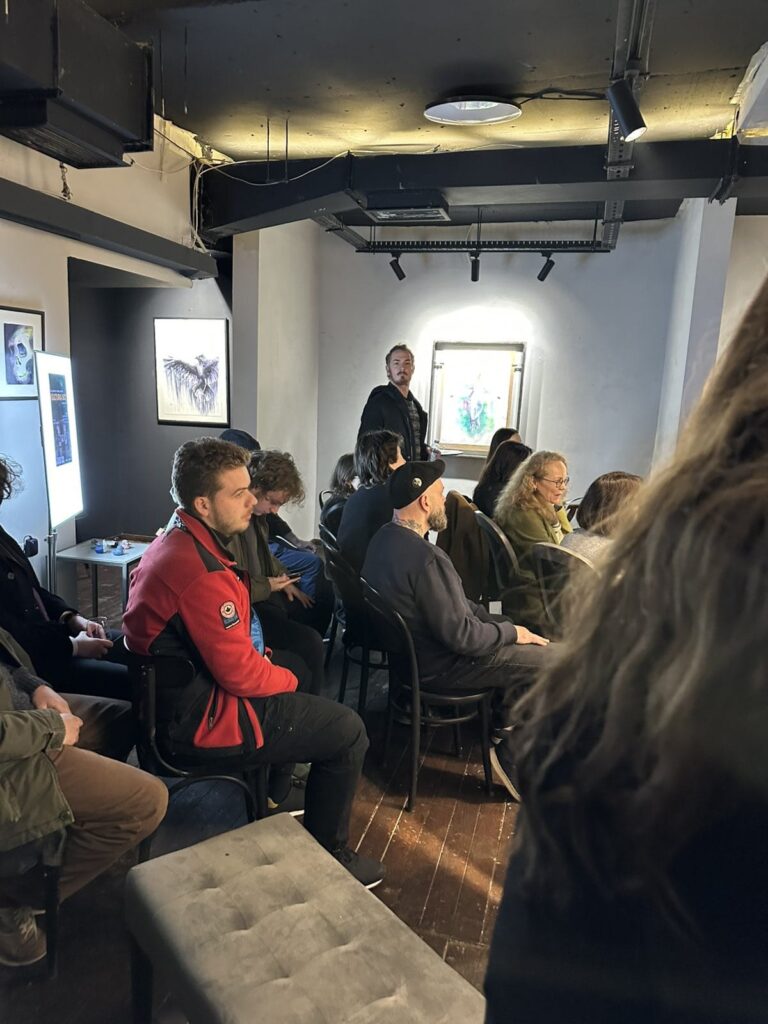
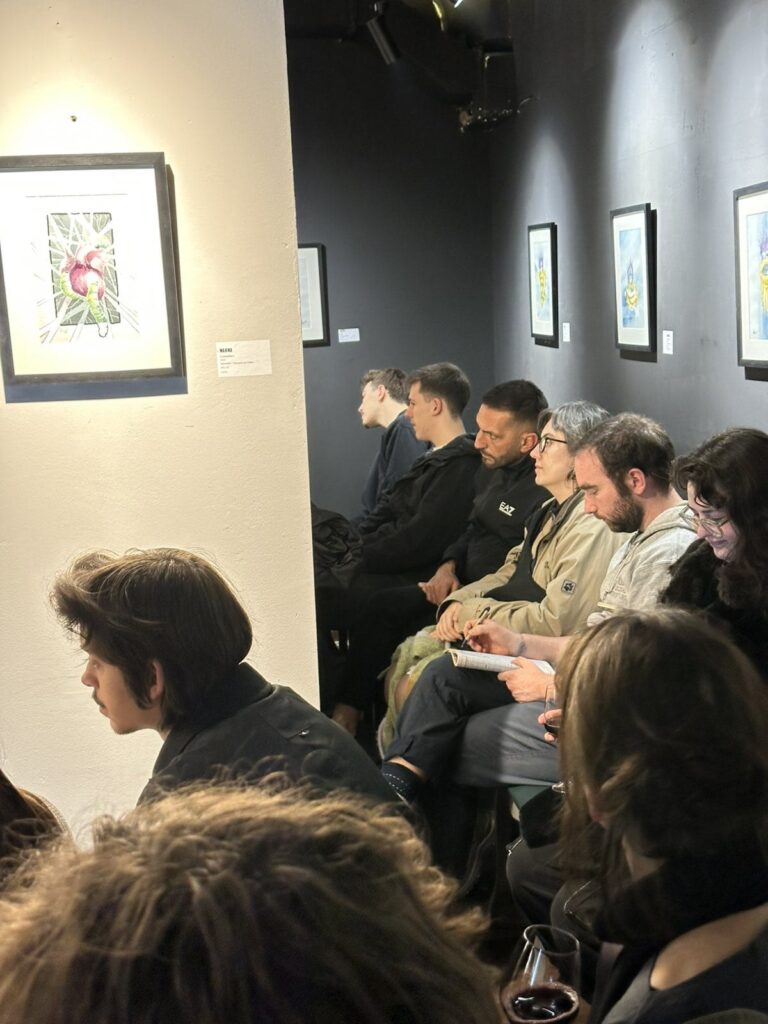
On February 26, at Hani i 2 Robertëve, the first meeting of the debate series Empowering Culture was held, under the theme “Culture Today.” The panelists in this first discussion were Labinot Kelmendi (philosopher, professor), Shkëlzen Maliqi (philosopher, publicist and art critic), Eliza Hoxha (architect, artist), and Mehmet Behluli (artist, professor).
The debate, which lasted more than two hours, sparked a broad discussion on the state of culture in general and on the developments of culture in Kosovo before and after the war. As a starting point for the discussion served the 2011 text “Post-war Culture in Kosovo” by Shkëlzen Maliqi.
The panelists shared their perspectives from the fields they come from and drew temporal parallels regarding cultural developments in the country. One of the issues emphasized during the discussion was that culture in Kosovo continues to have the alternative scene as its main catalyst, or what the panelists referred to as “cultural islands.” In this context, spaces and initiatives such as Termokiss, Oda, galleries that are not under the authority of the Ministry of Culture, Youth and Sports (MKRS), as well as various festival centers that are not necessarily financially supported by state institutions, were mentioned.
Have we culturally moved beyond the 1990s?
Shkëlzen Maliqi, among other things, emphasized that in cultural terms Kosovo today differs little, if at all, from the 1990s. The other panelists agreed with this assessment, raising an important dilemma: how is it possible that a country, which now exists in a completely different political and social reality from that of the 1990s, has recorded so little development in the cultural sphere.
According to the discussion, even under difficult circumstances during former Yugoslavia, cultural life in Kosovo was largely sustained through individual or collective initiatives, a reality that, according to the panelists, continues to be similar today. In many cases, culture relies more on these “cultural islands” than on stable institutional support.
“We have never truly moved beyond the 1980s or the 1990s, even after the liberation, after UNMIK and EULEX. In the sphere of culture, our basic situation is almost the same as in the 1990s, in the sense that our culture is based on individual or group efforts and is self-organized,” Maliqi stated, among other remarks.
During the discussion, Manifesta 14, the nomadic art festival held in Kosovo in 2022, was also mentioned. According to the panelists, it brought a necessary shake-up, especially for the alternative cultural scene. The interventions of Manifesta, in particular, transformed the capital into an aesthetically and artistically attractive space, both for the local public and for foreign visitors.
The greatest benefit from this event was experienced precisely by the artistic spaces and centers that already existed within the alternative scene and that received greater attention following the festival.
“For example, Manifesta is a very large event that came to Pristina in 2022, in competition with major cities. It arrived in cooperation with institutions, and many artists participated, including those who are more established on the artistic scene,” emphasized Mehmet Behluli, artist and professor at the University of Pristina, among other remarks.
On the other end of the spectrum
On the other hand, the panelists also addressed the relationship between institutions and cultural creators. According to them, institutions have not always been sufficiently cooperative with artists and creators from various fields, which has created a kind of vacuum in the development and well-being of culture in the country.
Eliza Hoxha, as an artist and architect, emphasized that culture cannot be defined in narrow terms. For her, culture encompasses much more than artistic production; it is also reflected in the way we dress, how we speak, and what we listen to.
In addition to culture in its broader sense, Hoxha also emphasized the importance of urban culture, particularly that of Prishtina as a city.
“It’s not that culture hasn’t existed as production, knowledge, tradition, craft, or belief, even in rural areas. But it has been capitalized and has taken on a different form. It has been musealized, interpreted, discussed, and elevated, yet also questioned by another generation for something new and for the future. Therefore, the city carries its own weight…,” Hoxha stated, among other remarks.
The discussion did not focus solely on culture as artistic production but also expanded to the relationship between culture and anti-culture, a topic that opens up philosophical debates. The oases where cultural activities take place, the fact that culture in Kosovo is still often perceived as a luxury, and the dispersed efforts between independent groups and institutions that provide partial support were addressed by the panelists in various ways throughout the debate.
Labinot Kelmendi expanded the discussion beyond the current perspective, focusing on the understanding of culture from an individual standpoint and on the importance of groups that view art as a form of revolt rather than as adaptation to social systems and structures.
“The most important expression for me to define culture is the German term ‘Kulturpessimismus.’ I believe that excessive optimism has led us to Auschwitz and Reçak. A dose of pessimism is healthy for viewing cultural undertakings with perspective,” Kelmendi said.
The debate on culture, past and present, on the question of whether anything has changed and, if so, where the greatest developments have occurred, as well as reflections on the importance of such discussions for the cultural scene in Kosovo, were some of the topics addressed during this meeting at Hani i 2 Robertëve.
This debate marked the beginning of a series of discussions aimed at placing culture at the center of public dialogue. The organizers announced that further debates would follow, featuring different themes and perspectives, as well as panelists from various fields of culture and society.
The next discussion will be held on March 11, under the theme “Public Culture and Independent Culture,” with guests Sibel Halimi, Jeton Neziraj, and Rozafa Maliqi, moderated by Diona Kusari.
The key points of the debate will include the relationship between public culture and independent culture, the reform of public culture, as well as the administration and independence of cultural communities.
Donjeta Abazi
Journalist

Shkruan Donjeta Abazi, Gazetare
The blog was published with the financial support of the Swiss Agency for Development and Cooperation (SDC) as part of the project “Empowering Cultural Expression.” Its contents are the sole responsibility of Hani i 2 Robertëve and do not necessarily reflect the views of the Swiss Agency for Development and Cooperation.