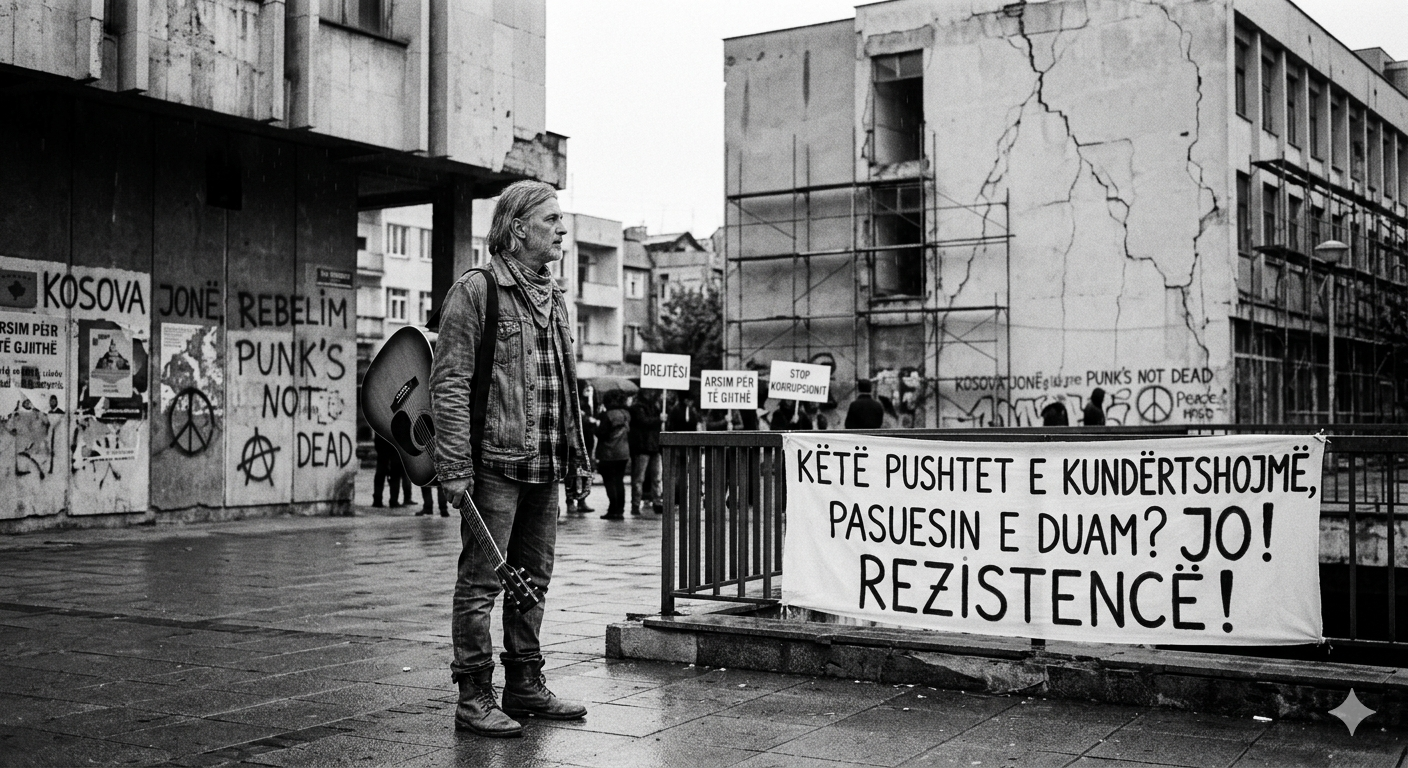
Photo: AI-generated, 2026.
I used to be a great admirer of anarchism, an anarchism grounded in conscious cooperation between people and communities. As I was growing up and immersing myself in various social movements, I embraced this current and political philosophy that challenged authority and social hierarchy. I was never a musician, but I have always felt a powerful connection to music, and I consider myself an eternal child of Rock and Roll. Through music and literature, I nurtured a steadfast belief that governments are often oppressive and, at times, unnecessary. In many ways, that belief seems to be confirmed today. The world is suffering from mass migration, failing education and healthcare systems, gender inequality and marginalization, institutional corruption, political polarization, rising living costs, threats and insecurity, hunger, and never-ending bullshit wars.
*
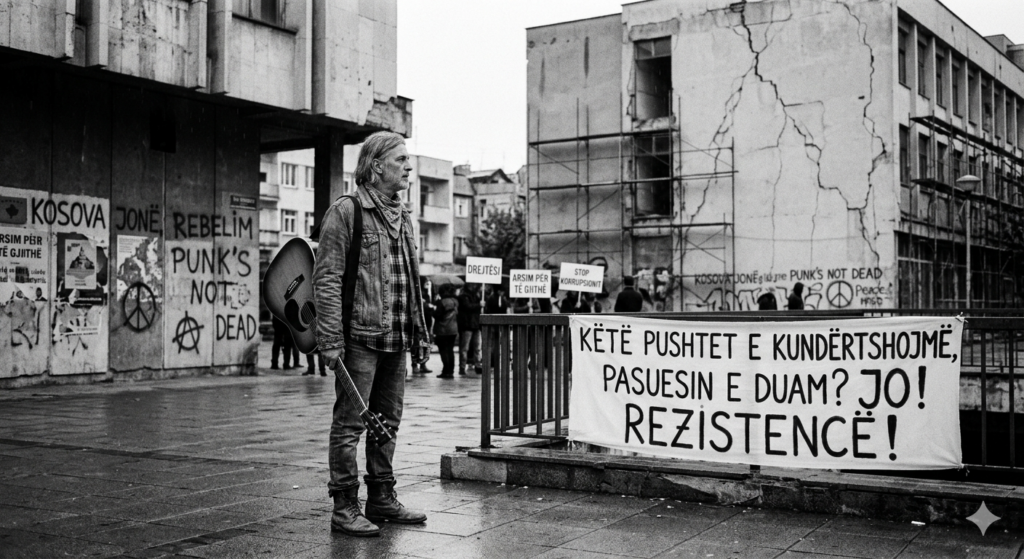
Our small Kosovo is facing institutional crises as a result of ongoing disagreements between political parties. In doing so, they have managed to create deep social divisions, unbelievable public lynchings, conflicts, and toxic relationships among citizens. No matter how constructive they may appear on television panels alongside narcissistic political commentators, the reality remains the same. This climate of hostility has been cultivated by all political parties, and yet there has always been civic resistance. Thankfully, there has been. Today, however, that resistance, especially the kind once nurtured by various cultural elites who aspired to a more humane and dignified life among people, appears to be in a state of clinical death. Those who were once outspoken have now fallen silent. Punks and contemporary artists, actors and directors, writers and musicians, poets and commentators, curators and dreamers, all turn their heads away. The legacy of Clown from Troja no longer seems to carry meaning. Not only within Troja, but across the broader contemporary Kosovar rock scene, it has become increasingly difficult to find traces of that anti-authoritarian spirit. Artists sing praises to their political allegiances, and the struggle for survival disarms them.
Today, there is not a single artistic initiative that openly challenges the current government. Artistic protest is dead, and individual freedom appears to have become a casualty of autocracy. The soul has become something easily exchanged for the comfort of an international village or a seaside home. Feminists who, until recently, maintained a deeply antagonistic relationship with power now aspire to it. Ironically, they do so under the same umbrella as religious clerics and traditions they once regarded with disdain. Unfortunately, many former punks have abandoned the convictions of their youth, their admiration for The Clash and the Sex Pistols, replacing it with admiration for political leaders or transforming themselves into institutional employees. We know that punk is fundamentally tied to social protest, rebellion against the system, unemployment, and oppressive politics. Urban and cultural elites have gradually transformed into political elites. Those who once opposed politically appointed boards, the use of children in political campaigns, and the symbolism of black government cars now remain silent and have embraced this political reality for years. The anatomy of contemporary power is composed, to a large extent, of these groups, or cultural “islands,” as a friend of mine once referred to these elite structures. Artistic criticism must remain active and continue to follow its eternal course: that of a healthy and consistently outspoken civic culture. One cannot oppose one form of power only to embrace another. The National Theatre has been under reconstruction for more than four years. The National Gallery has been under renovation for two years. The National Museum remains under renovation. The independent Oda Theatre continues to struggle. The theatre in Ferizaj is under renovation. I am not even sure whether the theatre in Peja still exists. Other theatres are waiting in line for the same fate, including the one in Gjilan. The Opera remains a fiction. The Kosovo Philharmonic and the National Ballet are without a permanent home. The board of the National Theatre is, in essence, a politically appointed board. Had such a situation occurred years ago, previous governments would have been relentlessly criticized and mocked, even accused of practicing a form of cultural fascism. Today, however, this reality has become normalized, and art has increasingly taken on the function of propaganda, with only a few exceptions. The National Theatre serves those who think alike and share similar political convictions. For years, not a single production within its already limited repertoire has offered a profound political intervention or embodied the spirit of political protest. In recent years, many artists have set their sights on parliamentary seats, abandoning some of the fundamental questions that art places before us. The American Paul Leroy Robeson argued that artists are guardians of truth, radical civilizing voices. Voltaire regarded politics as the art of deliberate deception. Yet it has been a long time since the Voltaires of this world were mocked, overturned, and pushed aside.
*
We oppose this one, but we love the next one, says the civic alternative.
Shpëtim Selmani
Writer and actor
The blog was published with the financial support of the Swiss Agency for Development and Cooperation (SDC) as part of the project “Empowering Cultural Expression.” Its contents are the sole responsibility of Hani i 2 Robertëve and do not necessarily reflect the views of the Swiss Agency for Development and Cooperation.