By Diona Kusari
During a weekend in May 2026, we had the chance to lead tours on Prishtina’s cultural scene and the impact of Manifesta 14 for a group of students from HBK Braunschweig, together with my colleague Amalia Koleka. Our work with Amalia in designing and conducting cultural tours has continued since 2022, when the Education Department of Manifesta 14 brought together a group of young people involved in the cultural scene to join its cultural and arts mediation program. Through this program, we worked together to research, collect texts, conceptualize, and lead five different types of tours throughout the biennale’s 100 days. These tours covered historical and political implications of 25 locations across the city and required the capacity to speak about the practices and works of 102 participating artists and collectives. Throughout this weekend, we found ourselves attempting to represent the current reality of Prishtina’s cultural scene while engaging in in-depth discussions about the impact of Manifesta with former biennale employees and a group of young people, most of whom had not visited the biennale in Prishtina. The framework of their visit, however, centered on learning from the inequalities and extractivism that big art institutions create and reproduce.
It is important for art institutions themselves to create, critique, and rethink their own terms and impacts, as well as to engage critically with the influence of the most visible art institutions. This global art scene has already become self-sufficient, as exclusive in its language and modes of operation as it attempts to be inclusive, thereby contributing to the creation of a self-perpetuating loop.
During its 100 days in Prishtina, Manifesta succeeded, on the one hand, in placing the city on the global map of contemporary art, and on the other, in attracting a local audience that was not the usual suspect of Prishtina’s artistic scene.
How can we apply the idea that the world is a reflection of ourselves to the manner in which we approach cultural events and cultural policy?
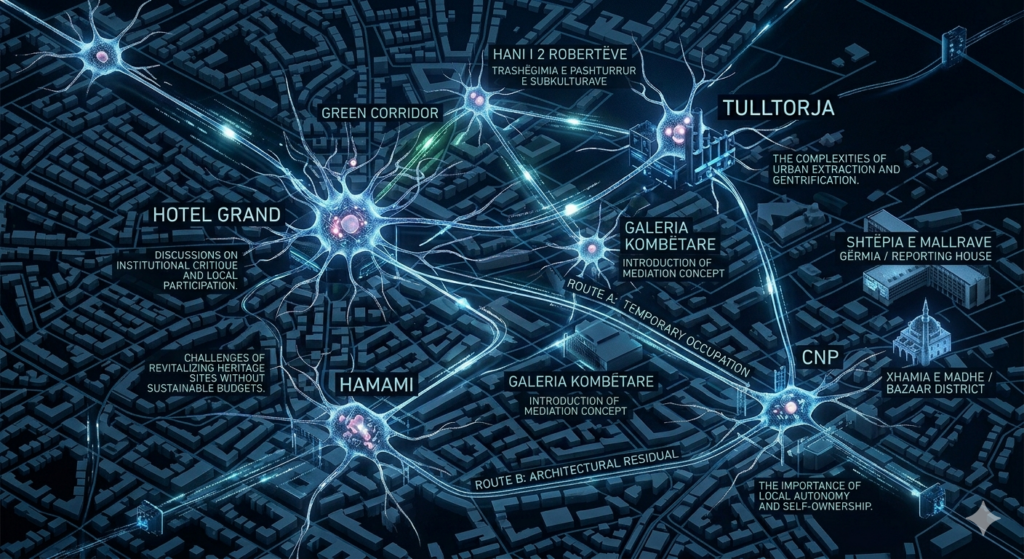
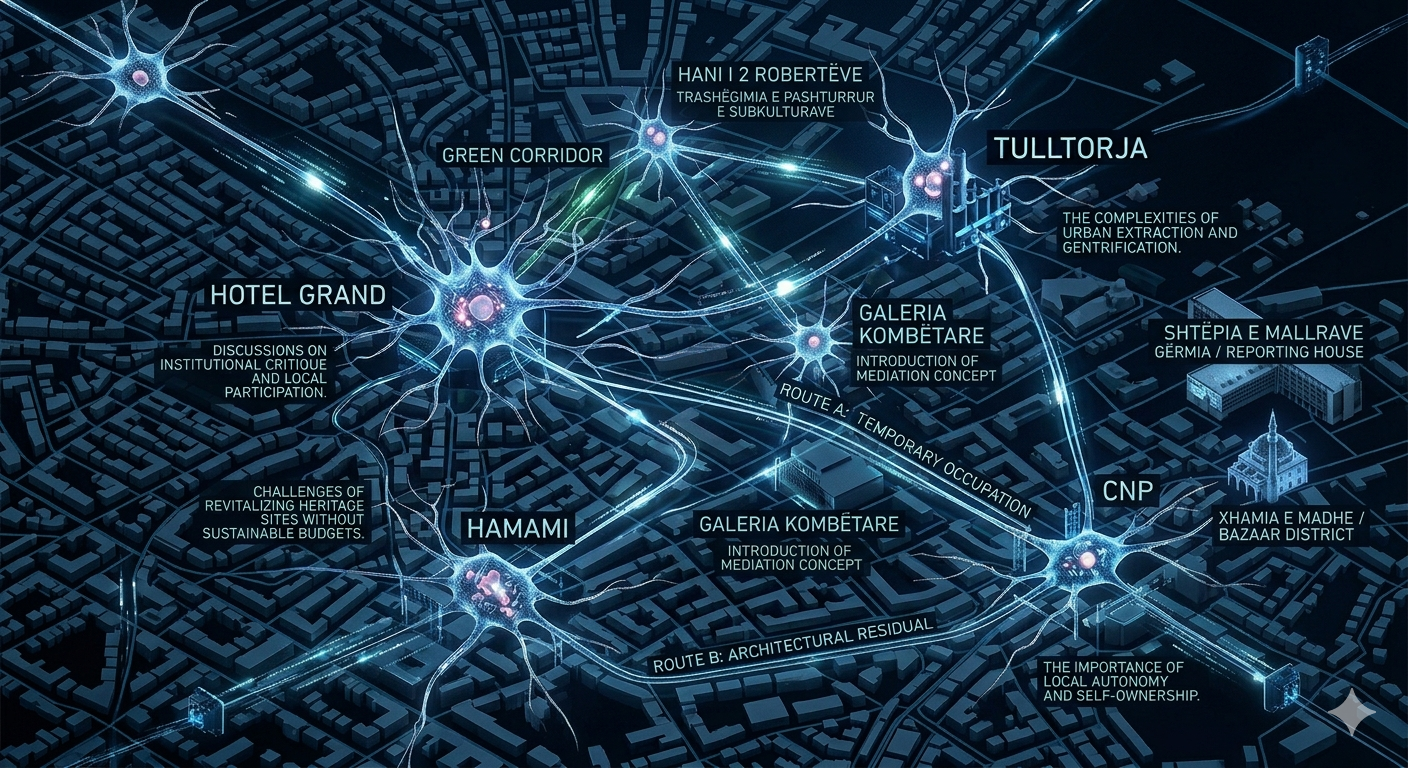
The arguments surrounding the successes and failures of Manifesta 14 have been numerous and diverse. Manifesta 14 opened up new ways of thinking about the use of nearly abandoned spaces, such as Hotel Grand, which is now home to a number of exhibition spaces and cultural initiatives (Hajde Foundation, Arti për Artistët, Barabar Center). It also produced “failed” experiments such as the Green Corridor and tried to activate spaces that still remain in a kind of limbo regarding their usability and appeal to local audiences, such as the Brick Factory (Tulltorja) and the Hammam of Prishtina. Perhaps Manifesta 14 also contributed to the reopening of the Gërmia Department Store as Reporting House, a kind of museum dedicated to the Kosovo War.
Manifesta gathered almost the entire cultural scene around itself, employing and exhibiting many of the country’s most active cultural workers and artists. Some argued that this made open criticism towards the institution rudimentary since so many of us had become part of it. Consequently, criticism appeared scarce or weak because almost everyone was involved in one way or another. Naturally, this is what happens when an institution manages to accumulate more trust, resources, and institutional support than any single actor within Prishtina’s cultural scene could ever hope to receive. On one hand, this scene is enriched by numerous independent initiatives which tend to be fragmented from one another at times; on the other, it becomes unified in reactionary approaches, such as was the case with the reaction of Punëtorët në Art (PART) to the institutional “occupation” of the Centre for Narrative Practice (CNP, formerly the Hivzi Sulejmani Library in Qafa).
Some would argue that Manifesta gathered local knowledge and used it according to its own needs. This perception seems to touch upon a collective trauma or perhaps a form of self-sabotage that manifests in our society as distrust and apprehension toward forces “coming from outside”, foreign institutions, and international donors. The discourse surrounding Manifesta 14’s impact often remains at the level of discussing how “outsiders” or imported institutions exploit and use us. Yet it seems to me that, at this level of discussion, we fail to learn the most valuable lessons that Manifesta may offer: lessons on autonomy, agency, and ownership over the ways we work, what we choose to do, and how we engage with public space.
In my work as a mediator for Manifesta 14, there were moments when my trust in the institution was shaken. One such moment occurred when the entire mediation team gathered its writings, creative work, and reflections on the mediation experience for publication by Manifesta 14. The institution ultimately chose not to support the publication, even after it had been compiled. Without institutional backing, funding, or legal clarity regarding whether this constituted our own creative work, we were unable to publish it independently. Nevertheless, Manifesta somehow introduced the concept of mediation to Kosovo’s art institutions, a practice later adopted by others, including the National Gallery of Kosovo. Often, the global art scene seems to view mediators as a source of inexpensive labor, young people who need not be paid much, yet who can still perform the necessary work of guiding audiences through exhibitions. The term “artistic and cultural mediation” was a missing piece within my own creative and educational practice. It became something I continued to explore, use, and reimagine through different formats of my work as an artist, guide, and art educator. I do not see my work as a guide for cultural institutions as a gift from Manifesta or as imported terminology, but rather as a concept and methodology that I have made my own over the past four years. I believe that creation and labor become ours, even when they originate elsewhere. Rather than assuming that something foreign has unknowingly wounded us, touched an old scar, or threatened to exploit us, and thereby materializing that fear into reality, we can claim ownership over what we adopt and transform.
Cultural institutions appear to be just as afraid of novelty and contradiction, or perhaps of their own inadequacies, as individuals are. Therefore, individuals must learn how to hold contradiction and advocate for themselves in relation to institutions. Last year, while living in Budapest, I shared a home with a young woman with disabilities and mobility impairments while we both participated in a program focused on performance and movement. Despite the critical awareness and language promoted by the institution, its formalized criteria made it easy to dismiss requests that would have acknowledged my friend’s reality and accommodated her needs. Ultimately, she was left to advocate for herself.
Do we still need reflection?
There is a constant need for reflection and integration, even though institutions, the stronger party, and at times ‘the abuser’, often seem incapable of recognizing or accepting the realities of those they have affected or harmed. Such an accelerated approach characteristic of Kosovo’s post-war period is not acceptable, whether at the micro or national level, as was the transition from Yugoslav socialism to neoliberal capitalism, which occurred without any meaningful process of integration or reflection. This is evident in the continued need to address the impacts of war, even nearly thirty years later. These remain the key stories that guides are expected to represent to foreign visitors in museums, exhibitions, or discussions about Kosovo’s contemporary film scene. I was unable to find information about whether Hani i 2 Robertëve was ever explicitly included in Manifesta 14’s published research mapping subcultures in Prishtina, Skopje, and Tirana. Hani is precisely the kind of extra-institutional space whose legacy is often overlooked or preserved only in the memories of older generations. Yet generational division is itself something reproduced by the local cultural scene.
Manifesta 14 revealed the existing tensions and weaknesses in the communication between cultural institutions and Kosovo’s independent cultural scene: distrust towards institutions, fear of the new and unfamiliar, and the fragmentation of the cultural scene itself except in moments of heightened tension that require solidarity. At present, Prishtina’s local government speaks of creating more cultural spaces; representatives of existing spaces speak of the lack of sustainable support they receive; and young artists engage with these spaces either by waiting for invitations or by approaching institutional leaders with hesitation.
Above all, it is clear that visibility places both institutions and individuals under scrutiny, making them simultaneously loved and hated. Yet contradictions persist in the way we approach cultural criticism and reflection in Kosovo. We reserve these conversations for private gatherings, where we criticize people the moment they leave the room because we are unable to be direct and honest with them. We post vague criticisms on Instagram stories rather than making them public, because the scene is small and we feel compelled to protect our reputation and future opportunities that might come from the very people we dislike or criticize.
I also observe this in the power dynamics cultivated by educational institutions and reinforced in hierarchies between professors and students. Those who feel smaller or less important often seem to constantly monitor what they say, do, and how they behave in order to protect their public image and persona. The contradiction lies in the belief that, in order to become recognized and legitimized, one must remain likable among established cultural actors and already-legitimized figures. In reality, respect is often earned by those who have the courage to dissent.
The clearest sign that we need criticism, even though we guard ourselves against the possibility of receiving it while micromanaging our public image, is the defensive reaction and resistance we display toward criticism itself.
Diona Kusari

Multidisciplinary artist, writer, researcher, and cultural mediator based in Kosovo. Her work focuses on materializing the invisible, whether it be belief or ideology, as well as challenging the assumed divide between the private and the public. She works within horizontally organized collectives, such as Potpuri, which focuses on self-publishing practices and the self-production of knowledge. She writes experimental poetry, blogs, reviews, and articles that center on cultural reflection and critique, addressing the virtual and the symbolic, and theorizing around topics of so-called public interest.
The blog was published with the financial support of the Swiss Agency for Development and Cooperation (SDC) as part of the project “Empowering Cultural Expression.” Its contents are the sole responsibility of Hani i 2 Robertëve and do not necessarily reflect the views of the Swiss Agency for Development and Cooperation.